There came a dove, an Easter dove, When morning stars grew dim; It fluttered round my lattice bars, To chant a matin hymn.
H. Cornelia Ray, 1910
On Easter mornings I find my church in the natural world, its congregation the crowd of living beings that surround me there. Often that means a walk into the woods above my home.
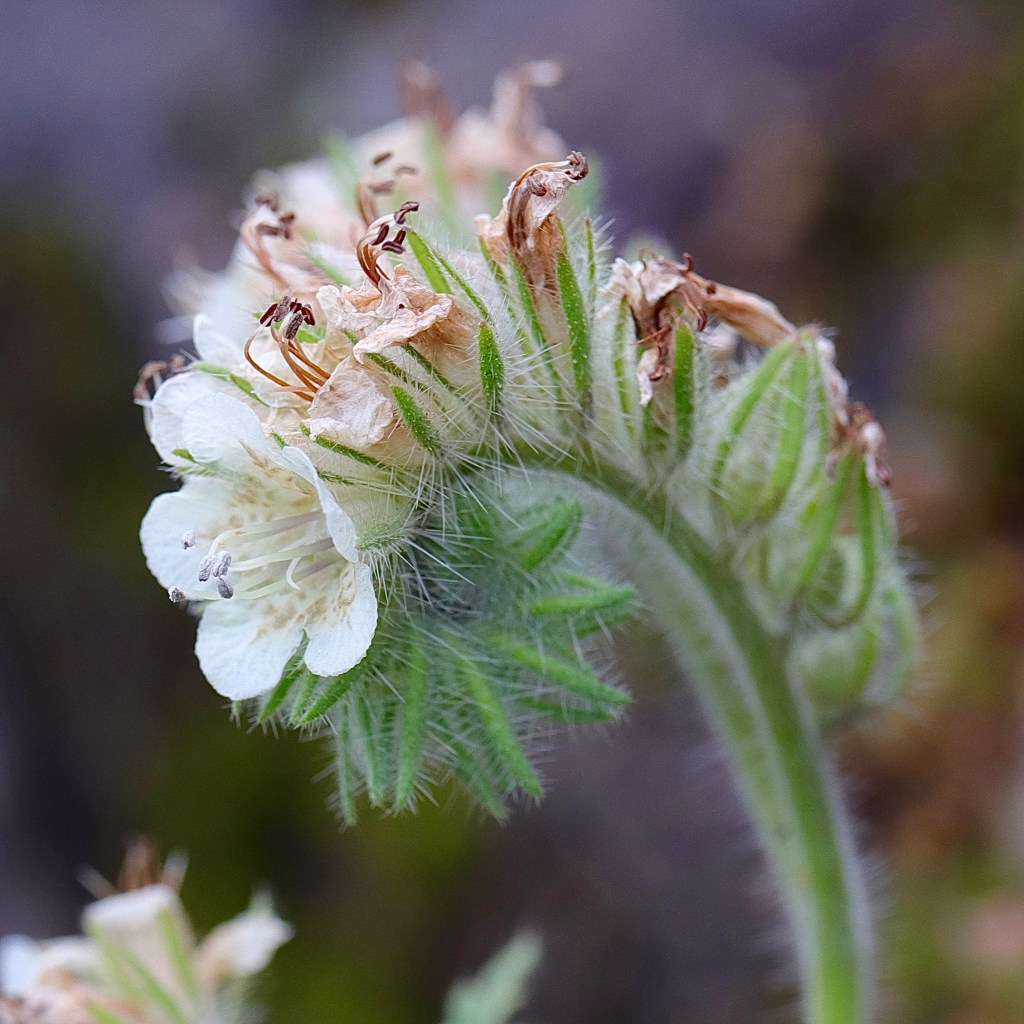
Yesterday, it was a series of wildflower walks in the rain a bit further afield. Goldfields on serpentine slopes, recurved flowers of dutchmen’s pipe vines suspended from branches of live oak trees, spiraling sequences of flowering and decay with caterpillar phacelia growing on warm exposures against rocks. This Easter morning it is up the hill above the house, rain over, ground damp and muddy, forest quiet as I enter, cloudy and overcast. Gradually sun comes out. Cloud shapes move across sky. The Easter bird chorus rises up as I find myself deeper in the woods, near the top of the hill — Spotted Towhee, Steller’s Jay, and Acorn Woodpecker, loud and shrill; beneath it the counterpoint calls of Orange-crowded Warbler, Ruby-crowned Kinglet, Oak Titmouse, Pine Siskin, Lesser Gold Finch, Dark-eyed Junco, Northern Flicker and Robin. This, I think, without really understanding why, is itself resurrection.
Raised knowing this as joy and faith, I now experience it as mystery. God, in the trinitarian sense, is both Depth, Person, and Spirit or Energy. The Father is the foundation, the depth, unknowable, the all and everything. The Son is the presence, the manifestation, the nexus that all reality is able to encounter, know, and be touched by. The Spirit is the movement, the divine energy that animates and connects, passes through us, and joins us with the unknowable depth and with the manifest, the incarnation. To experience God in this sense is to be bound up into this triangular dynamic – depth, person, energy. All of reality is fashioned of this, is marked with the sign of this. It’s proof-text, if you will, is the resurrection.
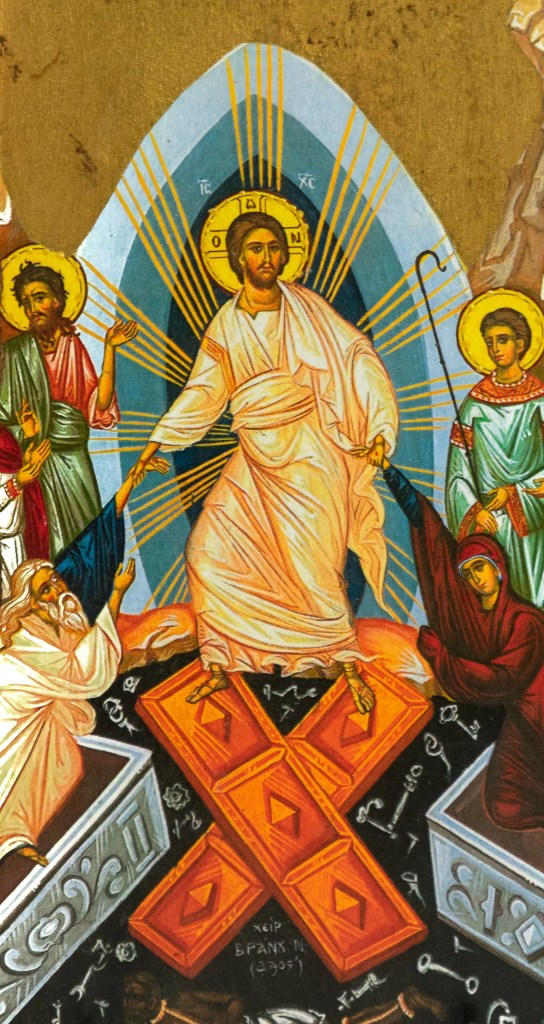
I love the Eastern Church’s icons of the Anastasis or the resurrection. The Christ, his robes flowing, descends into the depths of death and hell, breaking its doors, removing forever the need for any other key. Death is overcome. With hands outstretched, he lifts us out of death. Standing in the center, haloed by depth and darkness, radiating an energy that connects us to him, sorrow is no more. We are not lost in the pits of perdition. We are raised up with him, made whole, united with him, and joined into the limitless congregation of the eternal.
What then of the birds or the flowers? Is not salvation a human doorway, its doorkeeper an incarnation of the human? Are not the birds, the trees, the flowers, indeed all the rest of creation forbidden entry, without soul or divine spark, mere materiality meant only to decay and pass away? The Spirit tells me otherwise. These bird orations that fill the woods are too plaintive and more real, more real than our human chattering wordiness. The trees, voiceless, have a depth, a presence, that confronts me with their existence, their rootedness in things beyond me. If there is a resurrection, I keep finding it eternally present in all things. The Gospel of Matthew’s judgement parable where Christ enthroned speaks of the unknown Christ not recognized in each moment of the everyday is the Christ I seek to know. In that sense, the broken doors the Christ stands on in the icon stand for the closed doors that lock up one part of reality from the whole. Break down the doors between humans and nature, between privileged and poor, between races, genders, nationalities, religions. Break down the doors. He is risen. He is here. She is the Christ. They are the Christ. That orange-crowned warbler perched on a branch, itself budding out with the energy of spring, it too … is the Christ.
31 March 2024 / Coffeeberry Hill, Sierra Nevada Foothills, 2,800′
Diminutive, unassuming
flitting along branches looking for insects
Drab in its gray
only a small jaunty triangular crown to distinguish it
Its loud call nonetheless draws attention

Returning from the woods this morning
It stops me with a

Ts-e-e			Ts-e-e
	    twt			     twt


Repetitive, insistent, rapidly sung and more
percussive than melodic
Three short higher notes followed by one lower

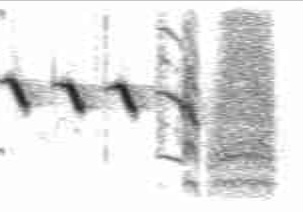
This ‘TSEET’ song as birders call it looks something like this in my recording


Perhaps similar to a recording of much greater fidelity in Cornell’s Macaulay Library


In both spectrograms a kind of sideways T shape
initial repeated notes followed by a raspier single note of multiple pitch
that comes to the ear more in the downward register.

As a symbol spectogram, something like this:

So it sings, this tiny bird of mighty voice
Calling out to the world
In alarm, in joy, in camaraderie
Perched in its tree, claiming its existence
As clear as the sunlight of morning

14
XI
21

Coffee-berry Hill
Clear morning, days after storm
Leaf-skinned autumn earth
Treading on it
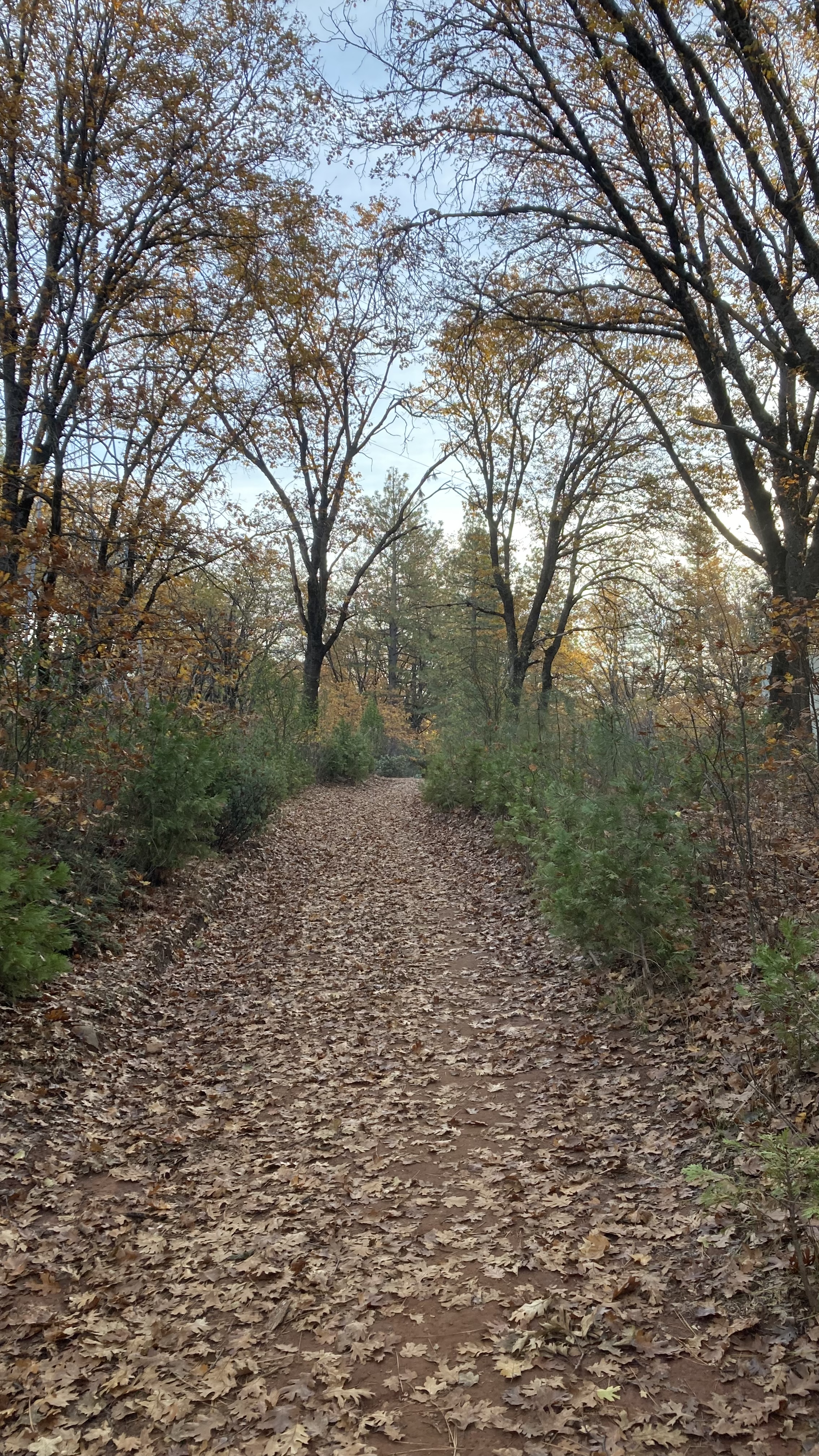
Climbing the path up black oak waving hill

Solitary horned owl hooting
Chittering kinglet, laughing pileated lord woodpecker
Complaining towhee kicking under manzanita
Their voices tread over hill also, deeper into felt-smooth dusk

Sitting on a boulder at the top
Kitkidizzee underfoot
Loud-toothed freeway in the valley
Eating silence

11
XI
21


Coffee-berry Hill
Moon past first quarter, Jupiter ascendant
“Beginning with where our feet first touch the earth, we send greetings and thanks to all members of the natural world.”
Braiding Sweetgrass, Allegiance to Gratitude Robin Wall Kimmerer
On November 13th, a day after COP 26 was scheduled to end, the final text of the agreement between nations meant to finally commit the world to act so that the planet reached no higher than 1.5 degrees Centigrade above historical average was released. There was new language, such as a commitment to “phase down” emissions of fossil fuels, and various other agreements relating to methane reduction, deforestation and a re-commitment on the part of the global north to fund climate mitigation for the global south. Yet, participants and activists alike suggested that it was not nearly enough. As a global society we are acting too little, too late, with endless qualifications, caveats and refusals. Decades of incontrovertible science, political effort and activist protest has barely slowed the pace of an ongoing catastrophe that threatens to destroy the foundations of global civilization itself. Why have we been so unable to act to save ourselves?
Perhaps our democracy itself is the problem, showing itself to be fragile and flawed, unable to respond to the challenges of the crisis. Multi-national institutions have failed to bring the world together with common purpose. Governments have veered back and forth in their commitment to meeting the emergency, taking decades to make any progress or dismantling progress when new parties come to power. Factions have successfully promoted ‘essential’ needs that make action on climate change undesirable, often minimizing or denying the very reality of the situation. Countries are moving away from democracy and toward authoritarian rule. Science is derided as fake, and conspiracy is taken as gospel. When nations meet for a 27th time next year will its ‘actions’ be enough or just another example of our failure as a species?
If there is a way out it is in questioning the roots of our ‘global democracy’ and freeing it from its fatal flaws. And the flaws are easy to see. Athens, that lighthouse of modern democracies, was fundamentally a slave state, with about a third of its population held in slavery. Rome, whose republic has been held as a model for our legislatures and legal systems, also maintained itself through slavery and the oppression of others, and itself failed as a democracy, succumbing to dictatorship and empire. Further, all of the urban societies emerging out of the advent of agriculture based their success on unsustainable ecological practices leading to saltification of crop land, deforestation and species extinction. Democratic or otherwise, the human project that led to urban centers and states created the fundamental human problems we have been faced with since — inequality, injustice, oppression, poverty, war, ecological destruction.
Our modern democracies of the global north, emerging alongside mercantilism and capitalism, did not so much atone for the ‘sins of their fathers’ as add to them. To slavery, inequity, oppression, war and ecological devastation was added the invention of race and racism, and the supremacy of capital or corporate interest over the individual. The idealism of our modern age has often only covered over the fundamental injustices found at the root of our democracies, instead of cleansing them of its deficiencies. Democracy “of the people, by the people, and for the people” has not so much been in danger of perishing as Abraham Lincoln suggested as being in danger of never fully being born. Our modern democracies have always been partial and constrained by anti-democratic forces built into its very design. If the countries of the world have not responded to the urgent reality of climate change it is no wonder. The interests of the many, the people, and the planet are continually neglected in the interest of the needs of the few.
More troubling, modern democratic capitalism has been the fundamental cause of our climate predicament. Democratic institutions protecting and enlarging the prerogatives and privileges of elites who wielded that power through capital and industry have made possible the emergence of a global carbon-based economy founded on open markets, exploitation of natural resources and the oppression of people. That this unfettered, ever accelerating project based in ‘fossil capitalism’ should lead to our climate crisis is a natural outgrowth of the system’s very design. The exploitation of resources and people from the beginning now threatens to extinguish the very civilization it created. Our modern democracies, in that sense, have been the blueprint of our own destruction and not the balm healing it. Partial democracy is an evil that allows the inequity and destruction build into its system to flourish while it points to ideals of peace, fellowship and common interest that are not being followed. It is no wonder that citizens often turn away from our ‘democracies’ and toward authoritarian movements based in emotion, hate and lies. Democracy is not alleviating their suffering. It is only continuing it and making it worse.
How then to better water the ‘tree of liberty,’ to nurture a kind of democracy that works? Jefferson’s prescription to water it with the “blood of patriots and tyrants” fits well the ‘revolutionary’ ethos of our modern age, but does nothing to understand the tree itself. We must plant the right kind of tree, one whose roots and branches embrace the whole, not just the part. We must look to the design of our democracies.
In the indigenous Haudenosaunee (or Iroquois) myth there is a sky tree that is uprooted in order for the world below, our world, to be. For the Confederacy of Five Nations that followed, an analogous ‘world tree’ became the central symbol of their democracy. It was the ‘Tree of Peace’ planted by the Peacekeeper himself, who instructed warriors of the five nations to bury their weapons under its roots before he planted it again. This tree became the unifying symbol of peace and unity for the Confederacy, with its four roots spreading to the four directions, with its eagle, sitting atop the tree, holding a clutch of arrows, watchful of the peace, a tree rooted in the earth, spreading out to embrace all people.
Can we not envision such a tree of peace, liberty and democracy for our world, turning to the indigenous understanding of the world that lies beneath all our new-fangled modernity and urbanism? To do so, we need to both challenge the inequities, racism, oppression and exploitation built into the system, but as important, embrace a deeper understanding of our connection with the world.
Robin Wall Kimmerer, in her Braiding Sweetgrass,** shares the story of the daily recitation of the Haudenosaunee ‘Thanksgiving Address’ at a nearby Onondaga Nation school where the students would share in reading it each week, teachers reminding students that “beginning where our feet first touch the earth, we send greetings and thanks to all member of the natural world.” All members of the natural world. This idea is so foreign to much of our modern world with its focus on the human, the individual, and its relegation of others, be they human, plant, animal or mineral, to mere resource. In the Thanksgiving Address, thanks is given one stanza at a time to a greater whole, giving each equal value to the human. The earth itself, seen as mother, the waters, the fish, the plants, our food and medicines, the trees, the animals, the birds, the winds, the lightning and the thunder, the sun, the enlightened teachers, and the creator, intending in that thanks to leave nothing out, and ending by saying, “Now our minds are one.”
“Cultures of gratitude,” concludes Kimmerer, “ must also be cultures of reciprocity. Each person, human or no, is bound to every other in a reciprocal relationship. Just as all beings have a duty to me, I have a duty to them.” This vision, embracing all beings and seeing a duty and responsibility toward all beings, is not unique to the Haudenosaunee or even indigenous culture, but it is far from the way our economic and legal gears operate in this ‘modern’ world. Seeing all species as ‘people,’ with standing and rights, seeing the ‘inanimate’ earth not simply as resource, but relationship, giving equity and equality to all people, starting with the great family of ourselves, humans, but continuing outward to all. Only in this way, with this kind of fundamental re-ordering of our vision can we truly address the climate crisis. For the climate crisis is simply the end-game of the long disaster beget by our inability to see the other as us, as connected to us, mutuality dependent, unable to thrive or survive without being in proper relationship, in reciprocity, with the other.
This, then, is the ‘metanoia’ to borrow the New Testament word, the change of mind and heart, that we all need. The bureaucrats and politicians, the scientists and engineers, the entrepreneurs and the corporate lobbyists will continue to offer their solutions within the system of modern democracy that has fashioned itself since the time of Columbus and the opening of a global civilization. Unless the technical fixes also embrace that change of heart, however, we will only continue hurtling toward our dark end. For a good two thousand years or more, the civilization project with its shining democracy has been on the wrong track, hinting at the great magnanimity of human creativity, wisdom and compassion, but only leading us in the end deeper into the abyss. Will there be a ‘great turning?’ Will, in the end, the best of our humanity lead us to return to the understanding that is our original inheritance as humans? I will start by giving thanks in the manner of all people who seek reciprocity and connection with all beings:
“Everything we need to live a good life is here on Mother Earth. For all the love that is still around us, we gather our minds together as one and send our choicest words of greetings and thanks to the Creator. Now our minds are one.”
Onondaga Thanksgiving Address As quoted in Kimmerer, Braiding Sweetgrass, Allegiance to Gratitude
16 XI 21 – Current Global CO2 at 414.57 ppm*
* Find our current global CO2 as measured by NOAA at the Mauna Loa Observatory by visiting Daily CO2 at https://www.co2.earth/daily-co2.
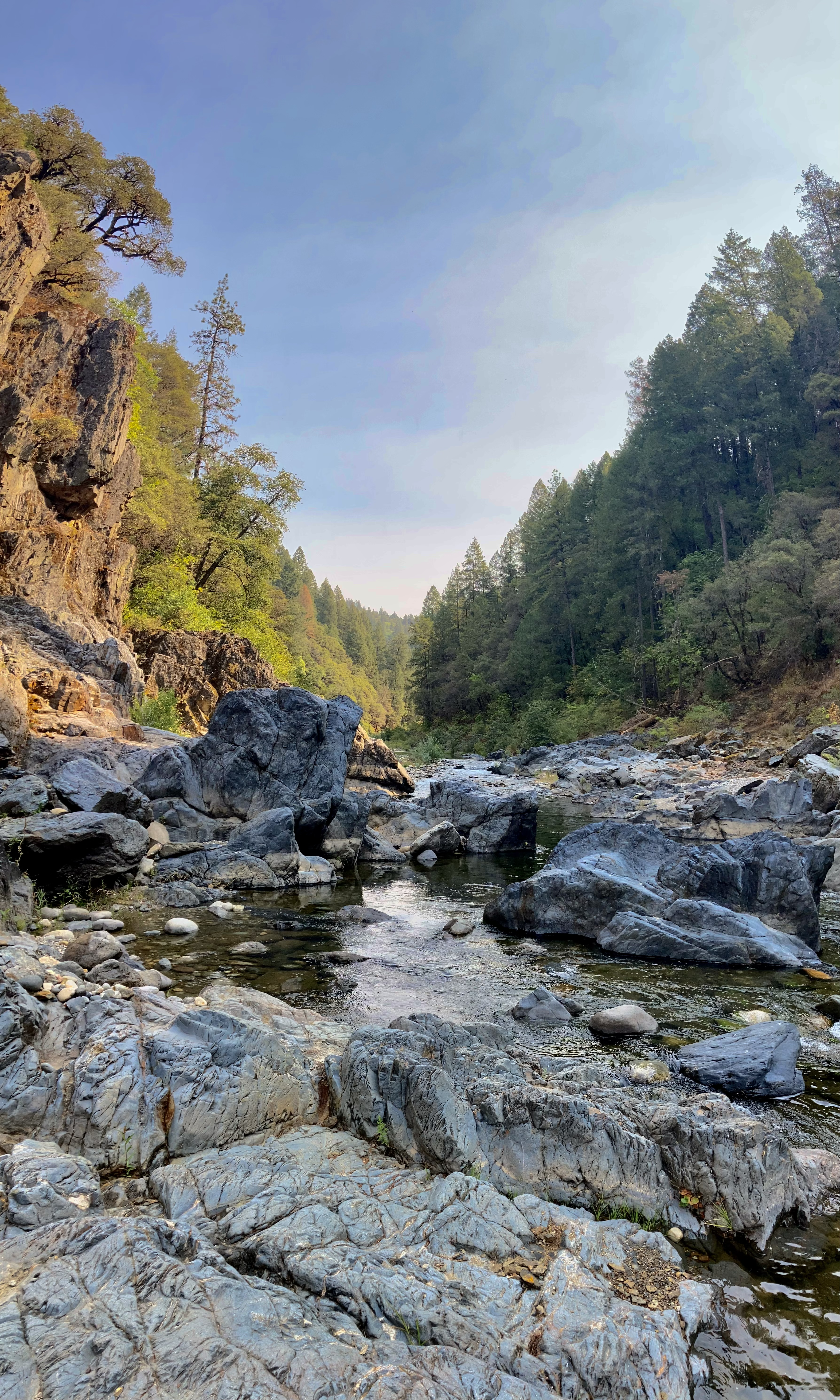
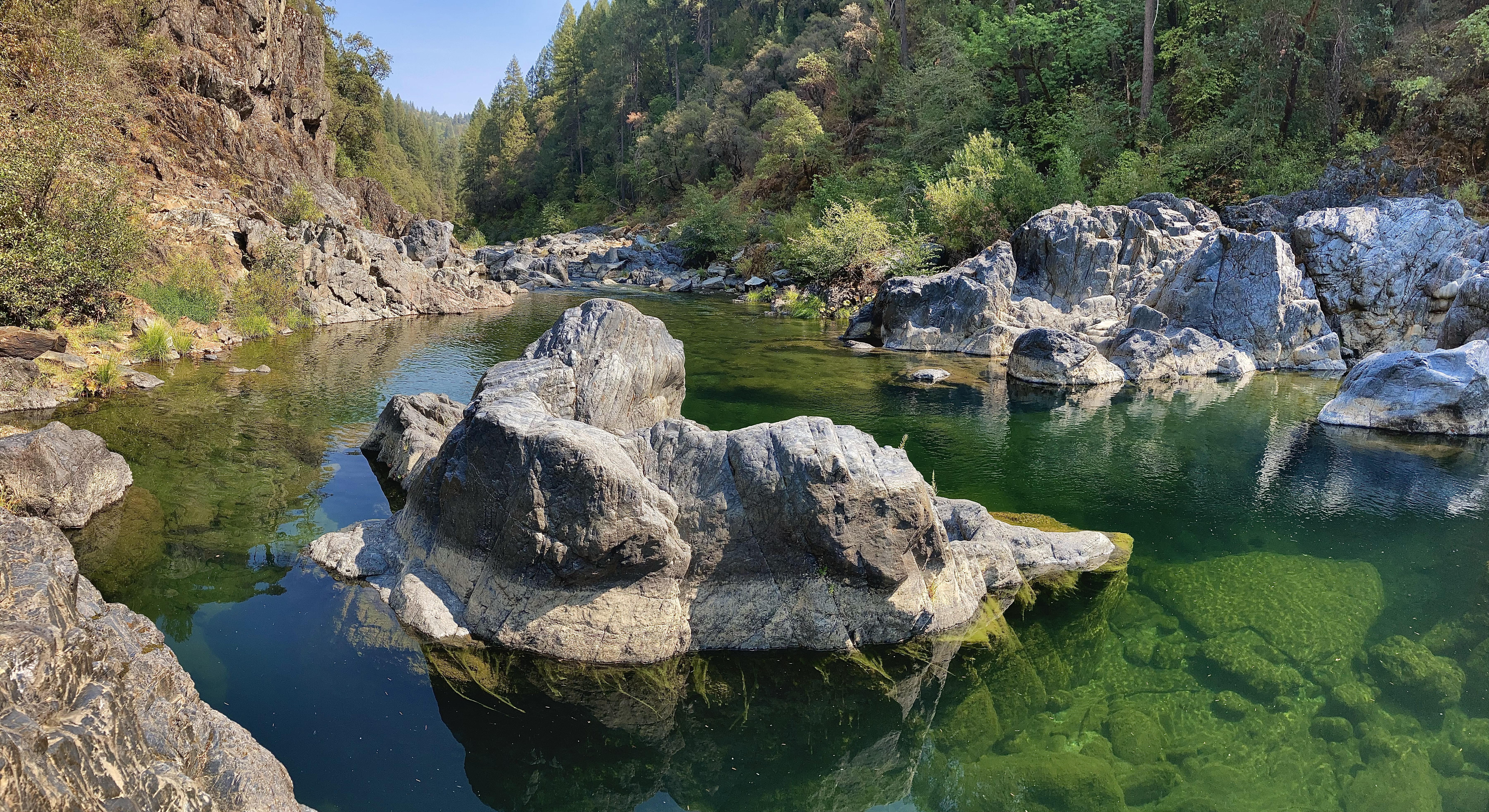
Mid September rain
	Dark fetid cups now
In hollows of blue-black rock shelves
	Angular metamorphics
smoothed by old river surges
	Holding perched granite cobbles
White on sand-strewn balconies above stream
Flat as table cloths

The forest
	Oak, ponderosa, maple, alder
It leans in from both sides
Ready to hear river’s long rap and rant
	Catching moisture
Standing back just enough from its floods

And we, much like kingfisher and ousel
That chatter up and back
We wander into the living narrow of earth
	Its rock gods
	Wood and water goddesses
Showing mute faces that choose not to reveal
	Unless we linger

Linger then
	Footsteps
Rest long your glances
	Restless eyes
Thoughts thrown up each moment with worries, plans and cares
They too can be washed down by river voice
Until naked
	Of thought, armorless
	Downstream wind becomes new fabric

River
	It likes that humility
That stillness well learned in the matter of turning rock
Into cobble, cobble into skein of sand

And I
less smoothed, rounded and perfect than river rock
None the less am more round for lingering here
Student to the flow of things
	That turns and carries
us all

21
IX
21


South Fork Yuba River
Clear morning
1,980’
Calm sky Endless forest Early autumn quiet Crackers, cheese and fruit for lunch
Water low now Its muddy bottom polished In stillness Cirrus pulling tendril threads Over blue sky Webs to catch our thoughts As they rise idly Into air
Summit Lake
2
Climbing down To water Guarded by block-barked Silver Pine Narrow, droopy-topped Hemlock Shadow-painted depths
That stuttering ‘kreek, kreek’ High in the sky
Sandhill cranes Flying back north across the dividing range Unfurling clouds Pausing to gape at their Drifting, insistent Flight
Shadow Lake
3
Autumn-yellow Spirea Edging the shallow Muddy, green-yellow surface
Spears and crescents Of refracted light Haloing the cliffs As one looks across Towards lowering Sun
Cliff Lake
26 IX 2020
Lassen National Park Moon Waxing Gibbous
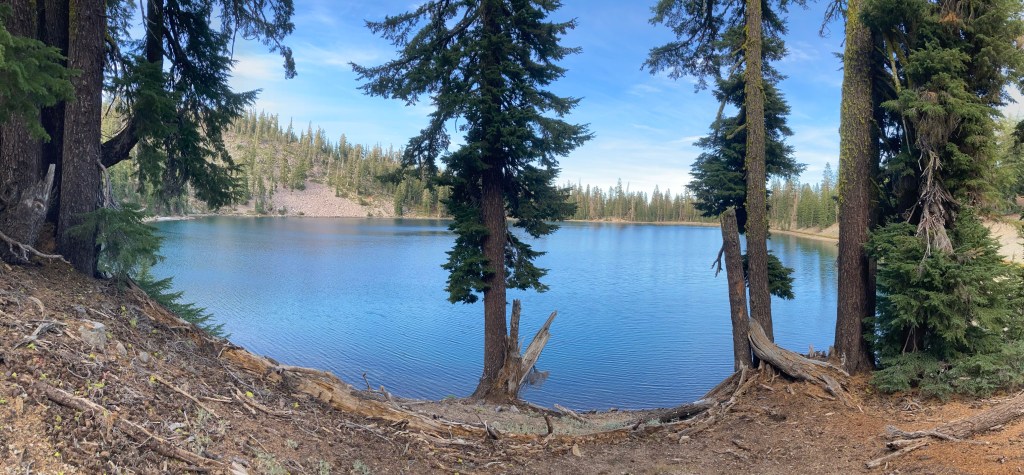
After visiting our daughter in Redding, a September day-trip led us to Lassen Volcanic National Park and a visit to a few of its glacial lakes. The volcanic rock holds fewer lakes than in the granitic terrain of the Sierra. So each lake is the more precious. Summit Lake is situated in open forest near the ‘summit’ of the main road that traverses the park. Shadow and Cliff Lakes are found along a 3 mile trail starting from a shoulder of Reading Ridge and both sit in glacial cirques carved out of the ridge. Forest is similar to the Sierra, but striking for its mature stands of Mountain Hemlock. Early autumn gave a crystalline clarity to the day. The photo is from the descent into Shadow Lake.
Sun turning day This once In the year Unpicked persimmons High in the tree Ripening to translucence Each its own miniature sun Against cold sky
Robins chattering In the canopy, pecking away At the tight-skinned succulent globes Even as we gather from below With our long pole.
With sun dying Forest, that swung its Photon-catchers Through the blue all day Stands still, black figures Chanting the silence That frames Low Jupiter and Saturn In conjunction
One solstice star This once In some 800 years As precious in its rarity As each breath I take.
21 XII 20
Cedar Wings Cottage Moon waxing Sky clear and hazy Between storms
Since the Halloween Full Moon of October we have been watching bright Jupiter & Saturn appear in the western sky after sunset, day after day becoming closer to each other and closer to the sun, as the moon cycled twice through its phases and chased its tail two times along the ecliptic — all messengers of the great cycling. Persimmon trees are also messengers, its fruits each autumn ripening as large orange-red globes clustered in the tree tops bare of leaves, an ornamented ‘Christmas tree’ striking for its abundant harvest offered in the gathering cold and darkness of the year. This once, there was the conjunction of tree and planet, as we gathered the last fruits from a neighbor’s tree and with darkness walked from the house to a place where low Jupiter and Saturn appearing as one, sparkling between the forest silhouette of tree branches.
Worlds away
on a wire
my father sings a raspy
hoarse-throated birthday greeting
over the telephone
He has always sung a bit off pitch
though earnestly, marked back to rhythm
by my mother’s truer voice

This time though
Each syllable
that comes to me from him
is a true island of being alive
He is calling from the hospital after surgery
raspy from pain, hoarse from
Anaesthesia
laying in a recovery room
as if on a narrow, unrailed balcony suspended
as we all are
between life and death

And I, who live far too much only in moments
between those assuaging oceans of anesthetic neglect
I too hover here on my imagined balcony
looking down at the things undone, upward
to the path-tokens of the way
the 9/8 murmur of snow turned to rain
in the gutters on the roof
cat curled on the chair by the fire
like an ouroboros
and inward to the bell-tone muffle of my heart
that passenger who travels the moments
with me, mostly forgotten.

Heart, tell me again my credo
Give me pause to listen
So that I walk well, pacing the moments
each such a gift
Hide not the sorrow or joy
Let me have ears for both and let them pass on
For I am my father in this moment
and he sings not for my birth
but for that thing that has always been unspoken
between us
That something that vibrates
outside of wires
or time, or any boxes of mind
so that, mother, father, all
we are a chorus.
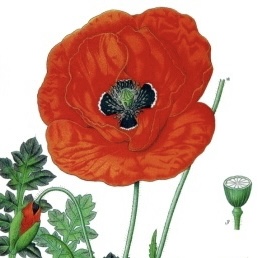
Years back In Flander’s fields I saw them growing still edging rows of wheat Along dirt tracks the tourists And the tractors travel Toward the heroes’ monument at Waterloo Red poppies, Papaver rhoeas French – Coclicot
In Ypres One hundred years ago They grew in fields disturbed By trench and bomb By muddy feet and shattered corpse Blood red their petals In an angry wind A stubborn resurrection Against all senseless Death
Today, across the world we wear facsimiles Upon our chests Walk solemnly to the grave Of soldiers whose names We will never know So many did they die and so fast In that almost forgotten global war
In America We speak of veterans And raise the flag Ponder war and peace And armistice An end to wars
All good To bow our hearts before the dead And give all honor to those alive My mother’s father He was there In France, while still a youth Who somehow joined America’s Expeditionary Force And then returned, no poppies Waving over his grave
Here On California’s shores Old European arguments fall short We look to check our facebook feed And armistice is a neglected word We claim our holiday And proudly stand with America’s might
Yet as I walk in fields And canyons Of this west-leading Continent edge I see our poppy Gold-orange not red catching the wind, coloring the land What war or peace does it Proclaim?
It whispers of a genocide In every hill How love of gold As strong and heedless As each poppies’ painted petals Like a battle wind Came here and pushed The native people out, enslaved Or killed them
Glorying, Even to this day In smiling forgetfulness Knowing only the industrious heritage Of crouching miners Pick-axed adventurers Nimble entrepreneurs All of us, grateful inhabitants Of a place we call The Gold Country
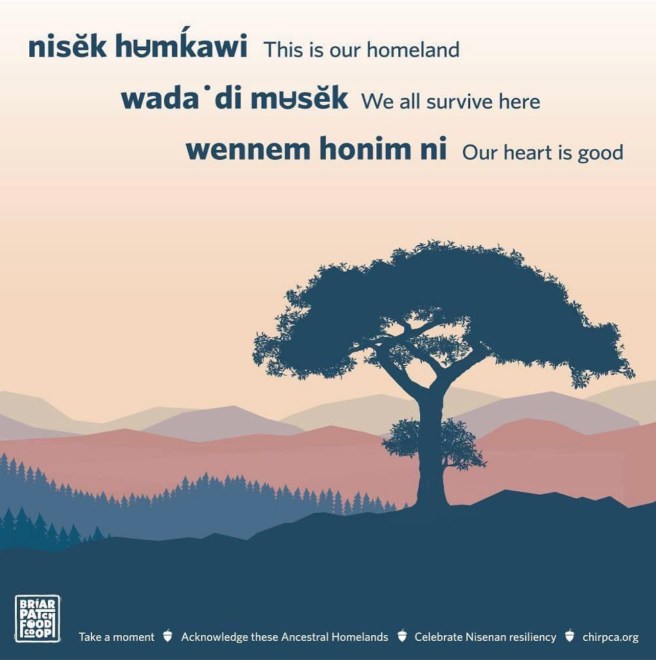
So better on this Armistice day Remember all our wars Our place within them Our poppy gold Not with greed or death But with renewal For people long forgotten Still among us, speak: We are Nisenan Nisek humkawi Wada’ di musek – This is our homeland We all survive here
11 XI 20 Sky clear, waning crescent moon On Ancestral Homelands Of the Nisenan
*Veterans Day, November 11th, began as Armistice Day, remembering the moment on the 11th hour of the 11th day of the 11th month of 1918 when an armistice ended World War I. In part due to the poem ‘In Flanders Fields,’ written by the Canadian soldier John McCrea in 1915 after the 2nd Battle of Ypres, the red field poppy became a symbol of Armistice Day and a way to memorialize the dead and the living who went through that war. For that reason, in the UK, Armistice Day is often informally called ‘Poppy Day.’ The California Poppy, Eschscholziacalifornica, the official flower and a common symbol of the state, is not closely related to Europe’s red field poppy, though it is in the same family, Papaveraceae. The Nisenan Ancestral Homelands stretch from the ‘Sutter Buttes’ of the Central Valley to the Sierra Nevada crest, including the Yuba and Bear River watersheds. It is in this region that some of the most intensive gold mining in the state occurred.
Moon
 Sun
 Night sky turning
 its stellar seeds into the mesa
 Wind
 Rain
 Snouts and bellies of cloud
 crowding over the ridge
 Ocean
 Waves
 The on-again-endless
 Booming of whitened, clapping hands
 Pelican, gull, curlew
 Heron, tern, cormorant
 Egret walking the white shadow of dawn
 cambering wings

 All
 A garment of life
 Kelp skirting the strand
 marking the arc of the strand.
 All
 An edge upon edge
 Gulls swirling in morning light
 Anemone gesticulating
 in filling tide pools
 All
 Crossing the boundary
 of each

 Within them
 Anisq'oyo
 Within the sun's course, moon's course
 Night sky course
 Within the wind's high highway
 its hoop of rain
 Within the boundary
 of ocean, its limit of wave
 All circling here
 Surrounding you
 Anisq'oyo
 Deep rooted earth of the center
 All the dancing, turning of years
 winds, hours
 All the singing of things
 Is for you

 All the singing
 is you
 Empty my voice and fill it
 With your voice
 Empty my heart and fill it
 With your heart
 Wind voice, rain voice, pelican voice
 Cormorant heart, ocean heart, night sky heart
 Heart that is always singing itself
 To its own center

 Sing me, make me yourself
 Anisq'oyo


 23 January 1984
 Campus Point
 UC Santa Barbara
* The University of California at Santa Barbara straddles a wide, south-facing peninsula framed by two points – Devereux and Goleta Points – and three lagoons. This mix of academic, residential and open space with its small sandstone cliffs facing the Pacific and coastal plain rising quickly behind to sandstone-toothed ridges of the Santa Inez Range was my physical and intellectual home for both undergraduate and graduate work. During that time Chumash elders performed a public ceremony in the middle of this Peninsula and shared the Chumash name of the place – Anisq’oyo.
 Perhaps similar to a recording of much greater fidelity in Cornell’s Macaulay Library
 In both spectrograms a kind of sideways T shape
initial repeated notes followed by a raspier single note of multiple pitch
that comes to the ear more in the downward register.
As a symbol spectogram, something like this:
In both spectrograms a kind of sideways T shape
initial repeated notes followed by a raspier single note of multiple pitch
that comes to the ear more in the downward register.
As a symbol spectogram, something like this:
 So it sings, this tiny bird of mighty voice
Calling out to the world
In alarm, in joy, in camaraderie
Perched in its tree, claiming its existence
As clear as the sunlight of morning
14
XI
21
Coffee-berry Hill
Clear morning, days after storm
So it sings, this tiny bird of mighty voice
Calling out to the world
In alarm, in joy, in camaraderie
Perched in its tree, claiming its existence
As clear as the sunlight of morning
14
XI
21
Coffee-berry Hill
Clear morning, days after storm
 Mid September rain
Dark fetid cups now
In hollows of blue-black rock shelves
Angular metamorphics
smoothed by old river surges
Holding perched granite cobbles
White on sand-strewn balconies above stream
Flat as table cloths
The forest
Oak, ponderosa, maple, alder
It leans in from both sides
Ready to hear river’s long rap and rant
Catching moisture
Standing back just enough from its floods
And we, much like kingfisher and ousel
That chatter up and back
We wander into the living narrow of earth
Its rock gods
Wood and water goddesses
Showing mute faces that choose not to reveal
Unless we linger
Linger then
Footsteps
Rest long your glances
Restless eyes
Thoughts thrown up each moment with worries, plans and cares
They too can be washed down by river voice
Until naked
Of thought, armorless
Downstream wind becomes new fabric
River
It likes that humility
That stillness well learned in the matter of turning rock
Into cobble, cobble into skein of sand
And I
less smoothed, rounded and perfect than river rock
None the less am more round for lingering here
Student to the flow of things
That turns and carries
us all
21
IX
21
South Fork Yuba River
Clear morning
1,980’
Mid September rain
Dark fetid cups now
In hollows of blue-black rock shelves
Angular metamorphics
smoothed by old river surges
Holding perched granite cobbles
White on sand-strewn balconies above stream
Flat as table cloths
The forest
Oak, ponderosa, maple, alder
It leans in from both sides
Ready to hear river’s long rap and rant
Catching moisture
Standing back just enough from its floods
And we, much like kingfisher and ousel
That chatter up and back
We wander into the living narrow of earth
Its rock gods
Wood and water goddesses
Showing mute faces that choose not to reveal
Unless we linger
Linger then
Footsteps
Rest long your glances
Restless eyes
Thoughts thrown up each moment with worries, plans and cares
They too can be washed down by river voice
Until naked
Of thought, armorless
Downstream wind becomes new fabric
River
It likes that humility
That stillness well learned in the matter of turning rock
Into cobble, cobble into skein of sand
And I
less smoothed, rounded and perfect than river rock
None the less am more round for lingering here
Student to the flow of things
That turns and carries
us all
21
IX
21
South Fork Yuba River
Clear morning
1,980’
 Mountaineity