There came a dove, an Easter dove,
When morning stars grew dim;
It fluttered round my lattice bars,
To chant a matin hymn.H. Cornelia Ray, 1910
On Easter mornings I find my church in the natural world, its congregation the crowd of living beings that surround me there. Often that means a walk into the woods above my home.
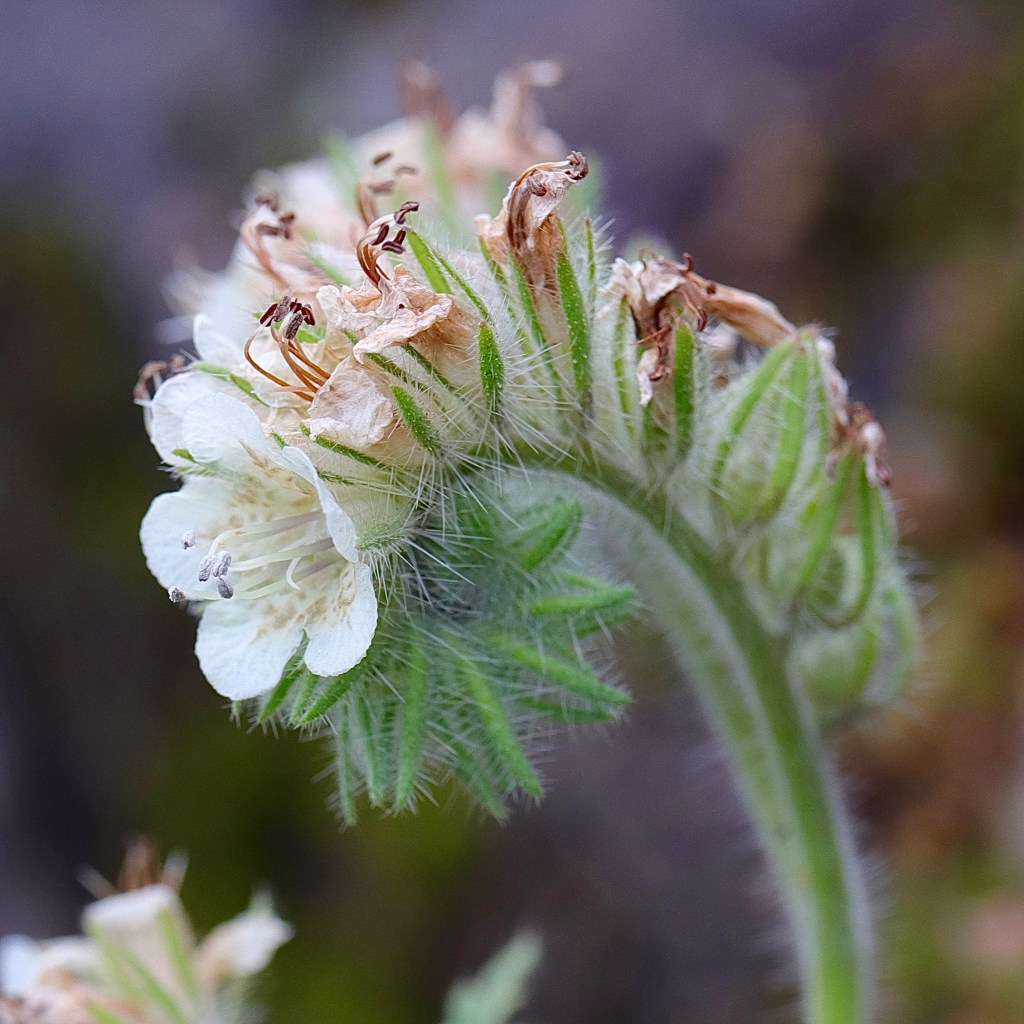
Yesterday, it was a series of wildflower walks in the rain a bit further afield. Goldfields on serpentine slopes, recurved flowers of dutchmen’s pipe vines suspended from branches of live oak trees, spiraling sequences of flowering and decay with caterpillar phacelia growing on warm exposures against rocks. This Easter morning it is up the hill above the house, rain over, ground damp and muddy, forest quiet as I enter, cloudy and overcast. Gradually sun comes out. Cloud shapes move across sky. The Easter bird chorus rises up as I find myself deeper in the woods, near the top of the hill — Spotted Towhee, Steller’s Jay, and Acorn Woodpecker, loud and shrill; beneath it the counterpoint calls of Orange-crowded Warbler, Ruby-crowned Kinglet, Oak Titmouse, Pine Siskin, Lesser Gold Finch, Dark-eyed Junco, Northern Flicker and Robin. This, I think, without really understanding why, is itself resurrection.
Raised knowing this as joy and faith, I now experience it as mystery. God, in the trinitarian sense, is both Depth, Person, and Spirit or Energy. The Father is the foundation, the depth, unknowable, the all and everything. The Son is the presence, the manifestation, the nexus that all reality is able to encounter, know, and be touched by. The Spirit is the movement, the divine energy that animates and connects, passes through us, and joins us with the unknowable depth and with the manifest, the incarnation. To experience God in this sense is to be bound up into this triangular dynamic – depth, person, energy. All of reality is fashioned of this, is marked with the sign of this. It’s proof-text, if you will, is the resurrection.
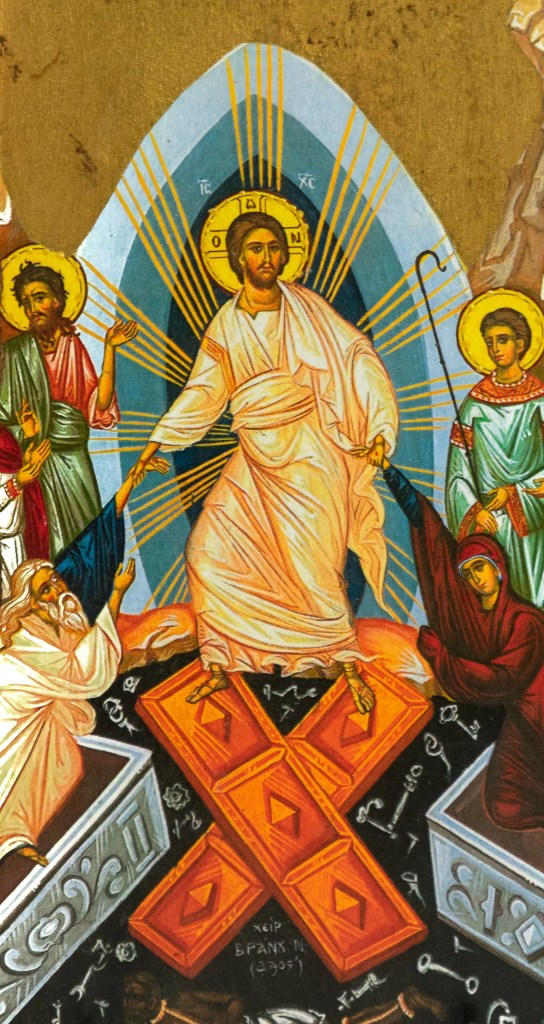
I love the Eastern Church’s icons of the Anastasis or the resurrection. The Christ, his robes flowing, descends into the depths of death and hell, breaking its doors, removing forever the need for any other key. Death is overcome. With hands outstretched, he lifts us out of death. Standing in the center, haloed by depth and darkness, radiating an energy that connects us to him, sorrow is no more. We are not lost in the pits of perdition. We are raised up with him, made whole, united with him, and joined into the limitless congregation of the eternal.
What then of the birds or the flowers? Is not salvation a human doorway, its doorkeeper an incarnation of the human? Are not the birds, the trees, the flowers, indeed all the rest of creation forbidden entry, without soul or divine spark, mere materiality meant only to decay and pass away? The Spirit tells me otherwise. These bird orations that fill the woods are too plaintive and more real, more real than our human chattering wordiness. The trees, voiceless, have a depth, a presence, that confronts me with their existence, their rootedness in things beyond me. If there is a resurrection, I keep finding it eternally present in all things. The Gospel of Matthew’s judgement parable where Christ enthroned speaks of the unknown Christ not recognized in each moment of the everyday is the Christ I seek to know. In that sense, the broken doors the Christ stands on in the icon stand for the closed doors that lock up one part of reality from the whole. Break down the doors between humans and nature, between privileged and poor, between races, genders, nationalities, religions. Break down the doors. He is risen. He is here. She is the Christ. They are the Christ. That orange-crowned warbler perched on a branch, itself budding out with the energy of spring, it too … is the Christ.
31 March 2024 / Coffeeberry Hill, Sierra Nevada Foothills, 2,800′
 Perhaps similar to a recording of much greater fidelity in Cornell’s Macaulay Library
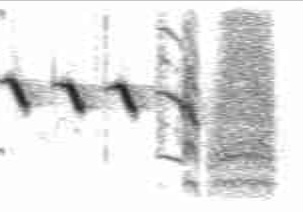 In both spectrograms a kind of sideways T shape
initial repeated notes followed by a raspier single note of multiple pitch
that comes to the ear more in the downward register.
As a symbol spectogram, something like this:
In both spectrograms a kind of sideways T shape
initial repeated notes followed by a raspier single note of multiple pitch
that comes to the ear more in the downward register.
As a symbol spectogram, something like this:
 So it sings, this tiny bird of mighty voice
Calling out to the world
In alarm, in joy, in camaraderie
Perched in its tree, claiming its existence
As clear as the sunlight of morning
14
XI
21
Coffee-berry Hill
Clear morning, days after storm
So it sings, this tiny bird of mighty voice
Calling out to the world
In alarm, in joy, in camaraderie
Perched in its tree, claiming its existence
As clear as the sunlight of morning
14
XI
21
Coffee-berry Hill
Clear morning, days after storm
 Mountaineity