Locus – a locality, a place; a place or passage in a writing, in the plural, a collection of passages…arranged as bearing upon some special topic or topics, a catena (chain of passages, as in Th. Aquinas’ Caneta Aurea, a commentary on scripture quoting earlier commentators).
New World Dictionary
21 October – What is this Place?
Question: What is this ‘locus,’ this place we all seek to stand in, dwell in as home, as body, as hearth, as that rightness and wholly connectedness, arrived destination never needing to be departed from, for it is us, is all, the nexus point between time past and future, center point encircled by all near or far away, that being there is so right that we know ourselves, see our original face, feel kinship, are connected to all the generations of the world, are at peace, are in our ‘place,’ home at last?
Perhaps we find it only when we slow down and become still. Perhaps we find it only when we become, as Thoreau suggests, simple:
“If, then, we would indeed restore mankind by truly Indian, botanic, magnetic, or natural means, let us first be as simple and well as Nature ourselves, dispel the clouds which hang over our own brows and take up a little life into our pores.”
― Henry David Thoreau, Walden, Economy
Much of Walden’s first chapter, Economy, with its complaint about “lives of quiet desperation,” and much of Walden itself, pursues this claim that living simply achieves a more restorative economy, allowing us to “take up a little life into our pores” when we find ourselves and our place outside the hurried, stress-driven human economy and inside the natural one.
So, to find our locus, our place, “Let us first be as simple and well as nature ourselves.”
Cedar Wings Cottage – 2680’
26 October – Beginner’s Mind
Mornings turn cold
Cirrus clouds gently painting sky
Trees still crowd close on the hill

Robins gathering
Announcing their errands
As they fly by

Sunlight, already catching
The last tomatoes in the garden
Turning them radiant, translucent.
“If your mind is empty, it is always ready for anything, it is open to everything. In the beginner’s mind there are many possibilities, but in the expert’s mind there are few. ”
― Shunryu Suzuki, Zen Mind, Beginner’s Mind
Morning is full of beginner’s mind. Fresh, not yet filled with the tasks, ruminations and reminders of ‘economic’ worries that Thoreau asks us to simplify, we are opened to the elemental nature of things. Trees on the hill are not background wallpaper put there to beautify while I drink my tea and plot the challenges of the day, they are trees, standing there with their immense mass, their shadows and movement of branches, their mysteriously grooved bark punctuated by ‘eye-holes’ where branches once were. So also with robins and juncos, with sunlight and tomatoes. All things are as they are, polished as it were in their nakedness, not yet dimmed or disregarded due to the films of inattention we place over them when we turn to the more pressing concerns that ego urges us to.
Let me, then, keep morning mind, beginner’s mind, all the day through, so that even the paper and pen, the screen and the keyboard, the car and the driveway all fill me with joy for simply being there. Let me linger in that convocation of beings, or interbeing as Thich Nhat Han would call it, for in that place are all possibilities.
Cedar Wings Cottage – 2680’
29 October – Watershed Consciousness
Stillness of morning air
Amplifies road noise from town
As it comes up the forested hill

Each to their practice
Chi Gong with feet on bare earth
Troops of Juncos foraging for seeds

Moisture high in the atmosphere
Heading east
Tumbling in and out of cirrus
…Community watershed consciousness, where people became engaged with their watershed regions as part of re-inhabitation, of becoming members of a place, of part of a decision to become a people who live somewhere, and who take responsibility for a place as members of that community.
—Gary Snyder, Watershed Consciousness
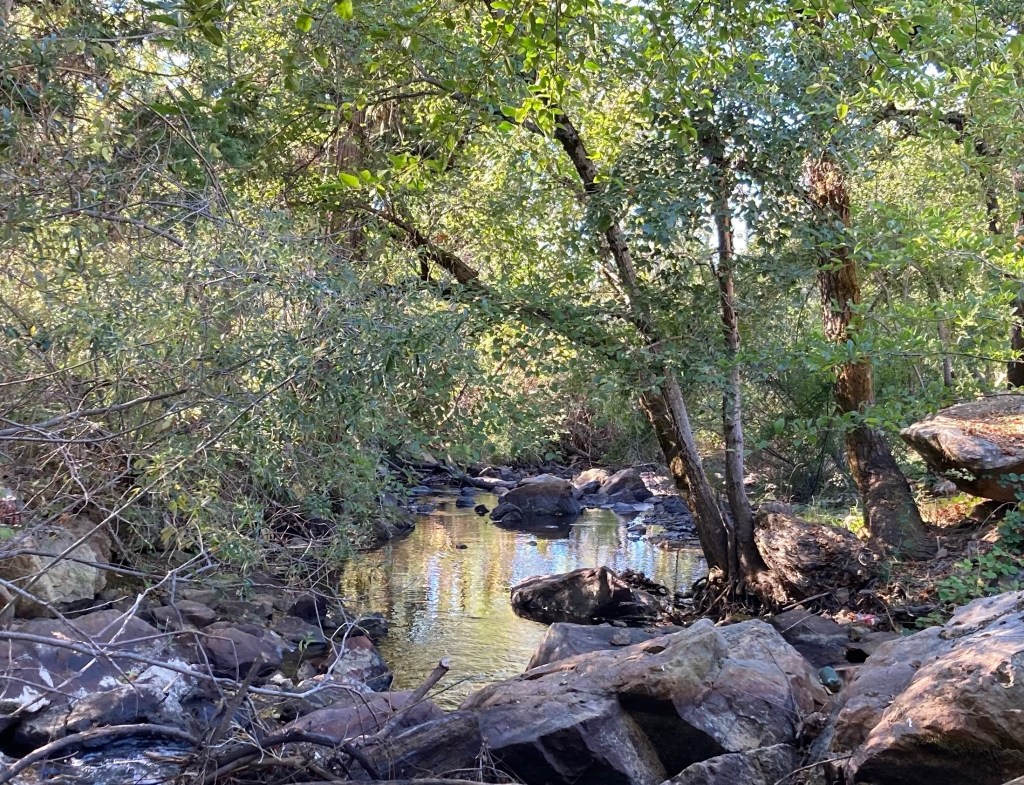
Standing on this ridge-top in the Sierra Nevada foothills, feet on bare earth, I find myself through watersheds. The South and Little Forks of Wolf Creek embrace me, draining from either side of this forested ridge. They join with the main stem of Wolf Creek as it flows through ‘my town,’ Grass Valley, then downstream to its confluence with Bear River, itself arriving from Bear Valley, higher in the mountains. Bear River joins the Feather whose headwaters are at the Sierra Crest north of me. And together the waters flow into the Sacramento, the Delta , into San Francisco Bay and to the sea. Held and woven together through cycles of water, carbon and nitrogen, this nesting of watersheds surrounds me, defines me, makes life possible, is my country and place, and in a real sense IS me.
As Snyder says elsewhere:
The watershed is the first and last nation whose boundaries, though subtly shifting, are unarguable.
—Coming into the Watershed
And within those unarguable boundaries, there is the opportunity to locate home, community, kinship and interconnection. We become “engaged,” “members of a place.” Instead of being foreigners, invaders, dispoilers or interlopers on the land, we “re-inhabit.” We begin to listen and learn from the land. In that first passage quoted above, Snyder goes on to suggest that such a listening and learning becomes an open questioning about the watershed we are within:
“How does it feel? How is life doing here? How are things all getting along with each other? What kind of a dance is this? How is the doing going? How is the music rising from it? How doe we feel when we walk the ridge or go down the river?”
—Watershed Consciousness
Gary Snyder, Watershed Consciousness
Let that be a daily practice, then: to know ourselves within this first and last nation that is watershed, to listen, learn, and ask questions of this place that is home.
 Mountaineity