A draft-book of notes, sources, questions and pathways
The climate catastrophe is the consequence of our continued in-terrability, our separation from interbeing, from the earth, from all beings, seeing ourselves as autonomous, as archons, rulers over subordinate ‘things.’ In this are the roots of racism, inequity, injustice, war, environmental collapse, extinction and self-genocide. If writing is to respond to this fundamental “condition,” then it must embrace the whole of it, in both problem and solution. This notebook is a jotting down of all that.
December 6th, 2020
- Can we Cool the Planet? — https://www.pbs.org/wgbh/nova/video/can-we-cool-the-planet/
- Exxon Holds Back on Carbon Capture Technology, Bloomberg Green, Dec. 7th, 2020. – https://www.bloomberg.com/news/features/2020-12-07/exxon-s-xom-carbon-capture-project-stalled-by-covid-19
The NOVA program on the scope of carbon emissions yearly and since the industrial revolution and the paths toward carbon emission reduction, carbon capture and sequestration, and increasing the reflectivity of the atmosphere. It’s helpful to see the challenges laid out in simple terms, in ways we can share and communicate to each other, joining in common purpose.
“A “giga” means “billion.” So, that’s a billion tons.
Nova, Can we Cool the Planet?
Now, we actually burn 10 times that much carbon every year. People actually go dig that stuff up out of the ground, 10-billion tons of it, and set it on fire in power plants, in engines, in factories, all over the world.
And then, because that carbon has reacted with oxygen, 10-gigatons of carbon is burned, but it creates 37-gigatons of CO2.”
The Bloomberg article focuses on how Carbon Capture has long been a technology associated with the oil and gas industry, primarily as a way to increase production (EOR – Enhanced Oil Recovery) and how companies like Exxon are not moving forward with carbon capture largely because it doesn’t yet fit into their current financial priorities. Also, for the oil/gas companies, small-scale Carbon Capture and Sequestration (CCS) projects are ways for these companies to greenwash their overwhelmingly polluting carbon footprint and advocate for access to more exploration and production.
“The world’s existing carbon-capture facilities can zero out just 0.1% of all global emissions”
Bloomberg Green
December 7th, 2020
• The Social Life of Forests, The Sunday Read, Dec. 6th, 2020, New York Times — https://www.nytimes.com/2020/12/06/podcasts/the-daily/tree-communication-suzanne-simard.html
• The Mother Tree Project of Dr. Suzanne Simard — https://mothertreeproject.org/
The podcast gives a deep look into the life and work of pioneering forest ecologist Dr. Suzanne Simard, who has led scientists to see the ‘social’ nature of forests, particularly through mychorrizal networks. It also explores some of the fundamental theoretical questions — How does evolution work, solely through competition, or also through cooperative networks, as individual species or also as ‘superorganisms’ on the level of forests or grasslands.
“Diverse microbial communities inhabit our bodies, modulating our immune systems and helping us digest certain foods. The energy-producing organelles in our cells known as mitochondria were once free-swimming bacteria that were subsumed early in the evolution of multicellular life. Through a process called horizontal gene transfer, fungi, plants and animals — including humans — have continuously exchanged DNA with bacteria and viruses. From its skin, fur or bark right down to its genome, any multicellular creature is an amalgam of other life-forms. Wherever living things emerge, they find one another, mingle and meld.”
The Social Life of Forests
“Five hundred million years ago, as both plants and fungi continued oozing out of the sea and onto land, they encountered wide expanses of barren rock and impoverished soil. Plants could spin sunlight into sugar for energy, but they had trouble extracting mineral nutrients from the earth. Fungi were in the opposite predicament. Had they remained separate, their early attempts at colonization might have faltered or failed. Instead, these two castaways — members of entirely different kingdoms of life — formed an intimate partnership. Together they spread across the continents, transformed rock into rich soil and filled the atmosphere with oxygen.
The Social Life of Forests
Eventually, different types of plants and fungi evolved more specialized symbioses. Forests expanded and diversified, both above- and below ground. What one tree produced was no longer confined to itself and its symbiotic partners. Shuttled through buried networks of root and fungus, the water, food and information in a forest began traveling greater distances and in more complex patterns than ever before. Over the eons, through the compounded effects of symbiosis and coevolution, forests developed a kind of circulatory system. Trees and fungi were once small, unacquainted ocean expats, still slick with seawater, searching for new opportunities. Together, they became a collective life form of unprecedented might and magnanimity.”
Simard’s Mother Tree Project is engaged in identifying, designing and testing forest renewal practices that bring together science and indigenous wisdom.
“Trees form mycorrhizae (literally meaning “fungus-root”), which are symbiotic relationships between trees and fungi. These mycorrhizal fungi have many branching threads (called mycelium) that grow out from the root tip of a tree and connect with the roots of other trees and plants to form a mycorrhizal network. The mycelium spans vast areas connecting trees and plants across a forest in an expansive underground network.”
The Mother Tree Project, Trees are connected
December 26, 2020
- Shrinking Caspian — https://www.sciencealert.com/climate-change-is-making-most-seas-rise-but-it-s-shrinking-this-one
- Great Lakes Water Levels & Temperatures — https://www.epa.gov/climate-indicators/great-lakes
“The expected escalating effects of Caspian sea level decline are likely to lead to a wholesale reorganization of ecosystems, and threaten unique Caspian biota that have been evolving in the basin over millions of years.”
The Other Side of Sea Level Change, Prange, Wilke, Wesseligh, 2020
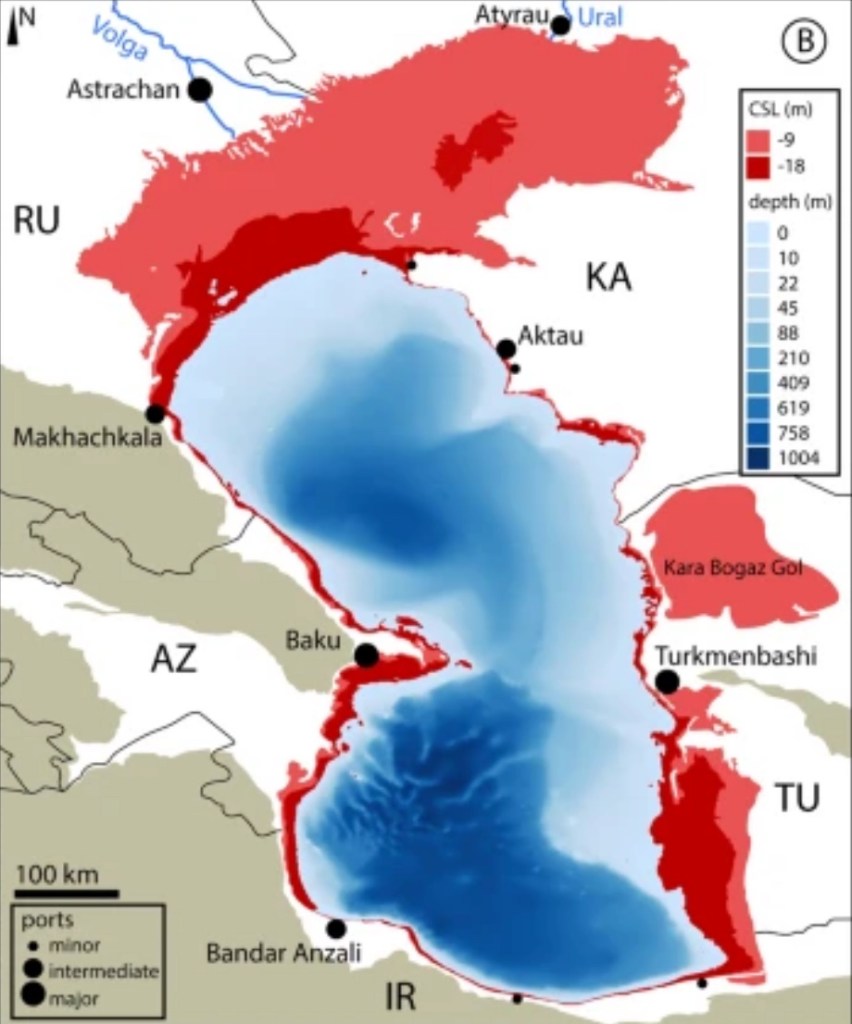
Even as ocean rise due to the expansion of water due to increased heat and the additions of water from melting ice the impacts of climate change appear to be the opposite in regard to lakes in continental interiors. A recent study of Asia’s Caspian Sea, the world’s largest lake, shows falling lake levels and potential for widespread ecological collapse, which, of course, would devastate economies of the millions of people dependent on the Caspian. The cause is decreased precipitation and river inflow, coupled with increased evaporation. All told, the level of the Caspian is decreasing “at a rate of 6 to 7 centimetres (2.4 to 2.8 inches) each year.”
“The impacts of the overlooked facet of future sea level change – falling levels of lakes and seas in continental interiors on a global scale – could be similarly devastating as global sea level rise, and threaten the livelihood of millions of people worldwide.”
The Other Side of Sea Level Change, Prange, Wilke, Wesseligh, 2020
What evidence do we have that other lakes are undergoing similar transformations. The EPA reports that North America’s Great Lakes, connected to the ocean via the St. Lawrence are indeed showing signs of fluctuation related to climate change.
The EPA’s 2016 report indicates:
- Water levels in the Great Lakes have fluctuated since 1860. Over the last few decades, they appear to have declined for most of the Great Lakes (see Figure 1). The most recent levels, however, are all within the range of historical variation.
- Since 1995, average surface water temperatures have increased slightly for each of the Great Lakes.
- Recent increases in water temperature have mostly been driven by warming during the spring and summer months (see Figure 2). These trends could relate in part to an earlier thawing of winter ice.
“In recent years, warmer surface water temperatures in the Great Lakes have contributed to lower water levels by increasing rates of evaporation and causing lake ice to form later than usual, which extends the season for evaporation.”
Climate Change Indicators: Great Lakes Water Levels and Temperatures
The impacts for humans has been ships forced to reduce their cargo tonnage and for the lake ecosystems the expansion of invasive species.
What of Lake Tahoe or Mono Lake much closer at hand? What of the many high elevation alpine lakes of the Sierra Nevada? Decreased snowpack will certainly have an impact. From the vantage of this moment I now will look on lakes with a new eye, gauging their potential for change, the ecological or economic disruption and the sense that the lakes I visit now may not be the lakes of ten or twenty years in the future. Just as I already mourn the ongoing loss of glaciers and snowpack in our own Sierra, now I look with a mournful eye at the potential of disappearing lakes.
 Mountaineity