Diminutive, unassuming flitting along branches looking for insects Drab in its gray only a small jaunty triangular crown to distinguish it Its loud call nonetheless draws attention Returning from the woods this morning It stops me with a Ts-e-e Ts-e-e twt twt Repetitive, insistent, rapidly sung and more percussive than melodic Three short higher notes followed by one lower This ‘TSEET’ song as birders call it looks something like this in my recordingPerhaps similar to a recording of much greater fidelity in Cornell’s Macaulay Library
In both spectrograms a kind of sideways T shape initial repeated notes followed by a raspier single note of multiple pitch that comes to the ear more in the downward register. As a symbol spectogram, something like this:
So it sings, this tiny bird of mighty voice Calling out to the world In alarm, in joy, in camaraderie Perched in its tree, claiming its existence As clear as the sunlight of morning 14 XI 21 Coffee-berry Hill Clear morning, days after storm
Tag: naturalist
Seeing Place
 Eastside
 Up the Little Truckee
 yellowing
 meadows, rusty willows
 Cold Stream Creek
 iced edges
 October’s early snow
 crescents against volcanic headwalls

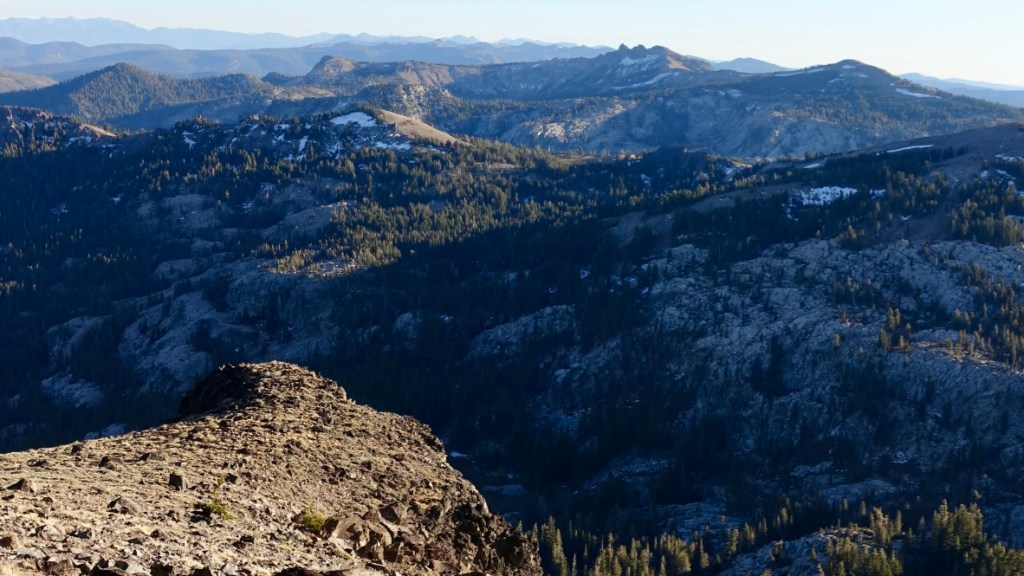
 Mt. Lola
 prominence highpoint
 November’s
 low-angled sun
 Sierra crest lifts choppy waves
 South, white-frothed
 All the way to Round Top
 Rose, in Nevada
 Arches her double back, east
 Lassen, leaning forward
 from far north
 close enough to taste
 with vision
 West wall of coast range
 holding the skirt
 of Central Valley, Sutter
 Buttes poking up
 through the haze and fog.

 All etched
 crystalline sky, dry autumn
 body laid out on its own
 operating table
 sagebrush summit
 white bark and mountain hemlock
 ourselves


 10 November 2019
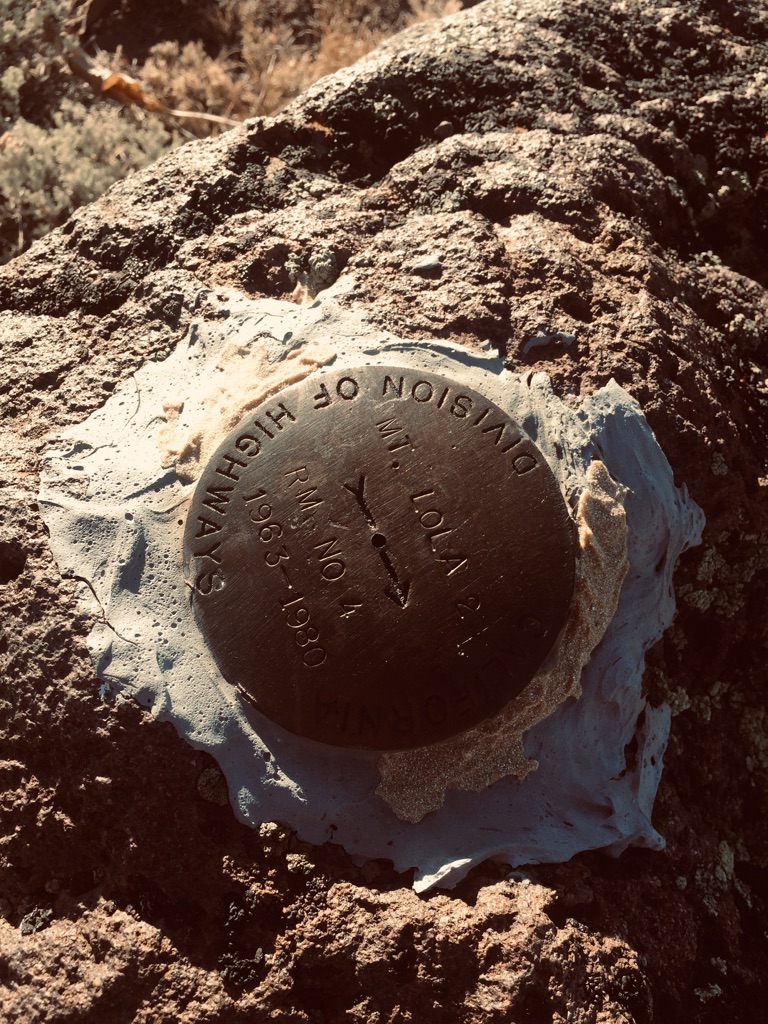
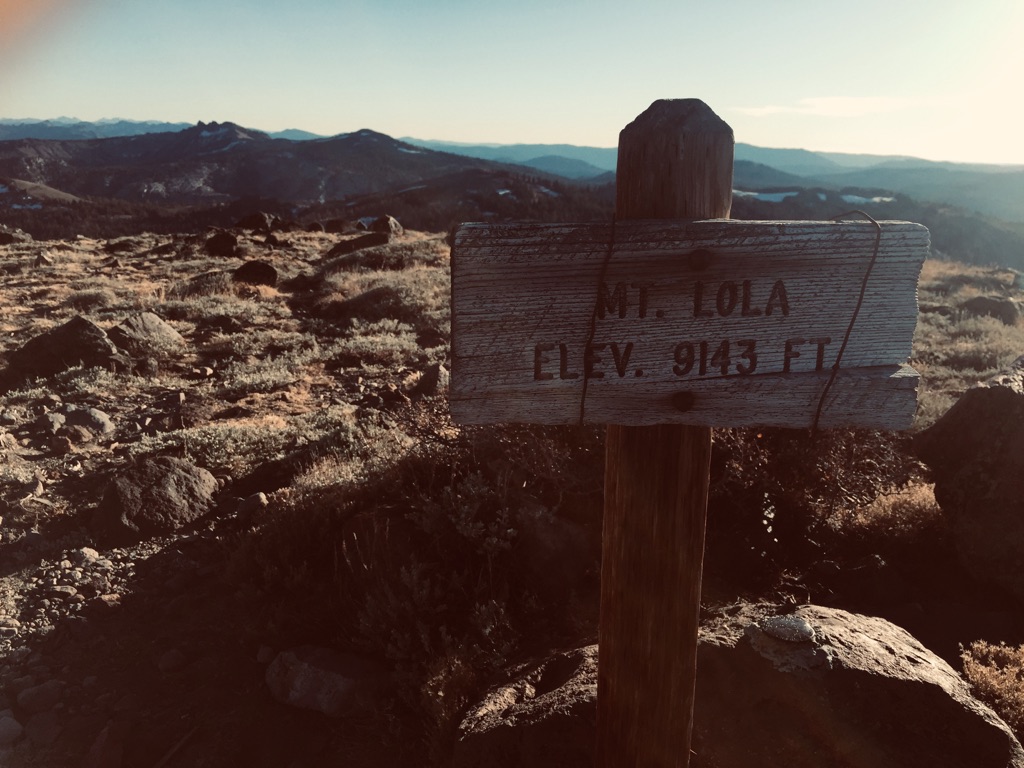
 Mt. Lola, 9,143’
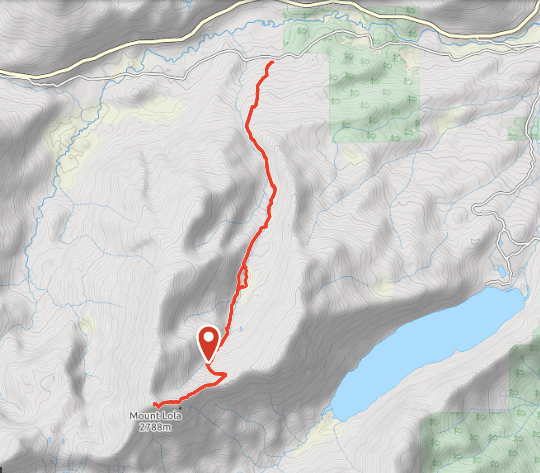
Turn off from paved road, to the right, crossing the Little Truckee river and taking the first right onto the old Henness Pass Road, dirt, about 4 miles total to the signed trailhead,
9 miles return, about 2.5 hours ascent, elevation gain +2,500′
A party of seven, leaving from the trailhead a bit after 11 am and returning in the dark at 6 pm. Spent 2 hours on the wide, open summit, taking in the view, the warm sun, sky clear, almost windless, exceptional clarity.
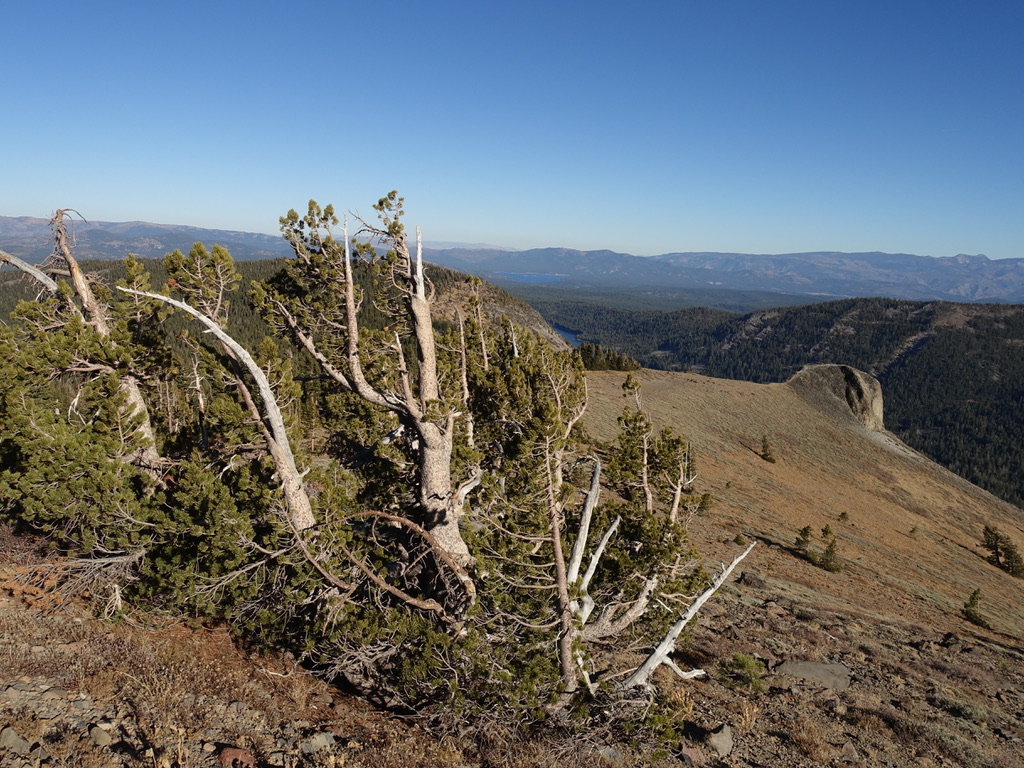
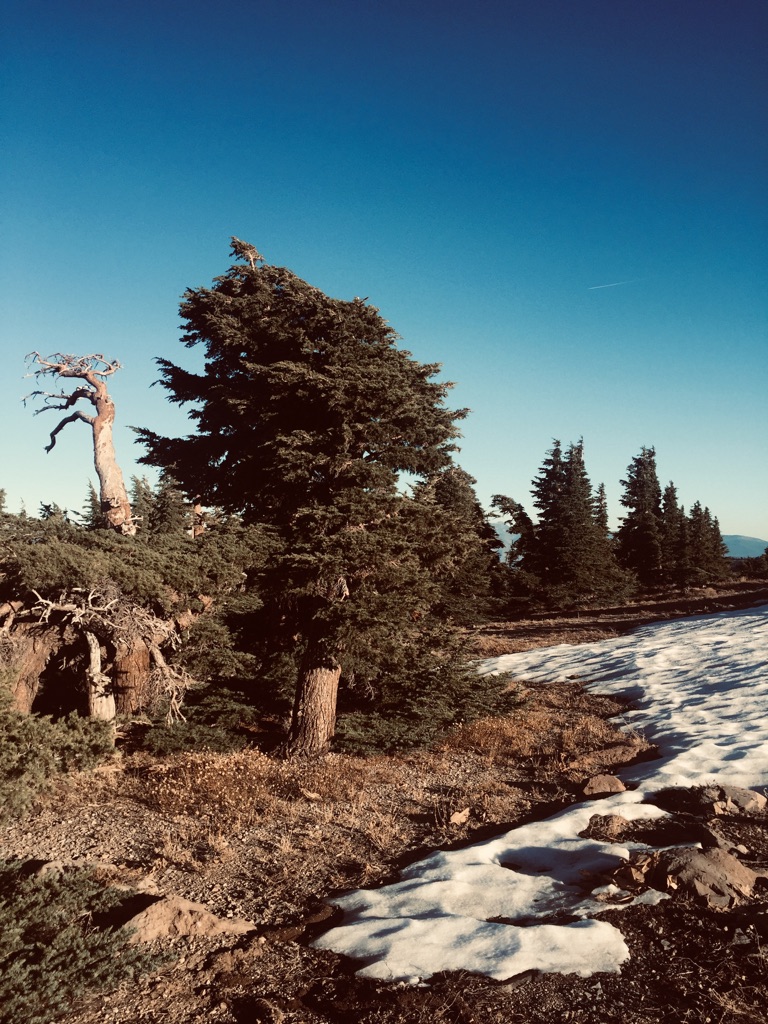
Upon close examination identified four conifer species on the summit in isolated stands — Jeffrey Pine (Pinus jeffreyi) on the warmer west and south slopes, Mtn. Hemlock down from the summit snowfields, Western White Pine (P. monticola) on the approach ridge, and one verified specimen of White-bark Pine (P. albicaulis), as indicated by the dense groups of 5-bunch needles, bark paler and less grooved than P. monitcola, and broken-apart cones at the base of the tree.
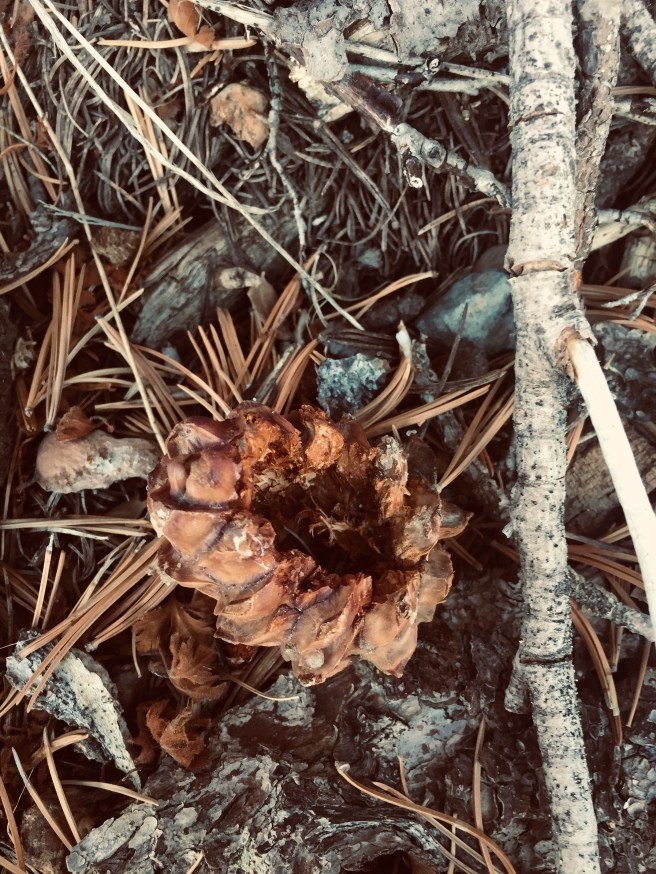
Along this section of the Northern Sierra, Pinus albicaulis is rare, occurring only on a few summits and ridges in the stretch between the higher Desolation Wilderness and the higher and more northerly Lassen National Park – Anderson Peak, Castle Peak and Basin Peak being the only locales presently identified. That the species can persist in very small numbers at wide intervals along the crest is intriguing. Clark’s Nutcracker, seen perched on a P. monticola during the descent, is a main dispersal agent. Further field work is needed to confirm rarity and distribution. This is hampered by the similarities between P. albicaulis and P. monticola, which is widespread on the approaches to the summits and adopts a ‘krummholz’ form very similar to P. albicaulis. Presence of cones is currently my only way to verify species definitively. For comparison, consider the cone of a Pinus monticola, found less than 10 meters away from the single, verified Pinus albicaulis:
Mt. Lola itself is a center post of this tent landscape that is the Northern Sierra. Highest peak in our Yuba Watershed and in Nevada County, it is also has a prominence of over 2,000 feet, the nearest such peaks being Mt. Babbitt to the north and Pyramid Peak in Desolation to the south. With its flat summit and long, high ridges it stands as a viewing platform for the Northern Sierra. One gazes almost to the Pacific, with the Coast Ranges forming the western boundary and the vast Central Valley spread out below. To the east, there is Mt. Rose and first ranges of the Great Basin, with the high, dry Sierra and Martis valleys in between. To the north, the first great volcano of the Cascades, Mt. Lassen, looms, with the last crests of the Sierra trailing off. To the south, most dramatically, the Sierra Crest builds with peak upon peak, gradually rising up to sculpted Pyramid Peak, Round Top, beyond Carson Pass, and wide-saddled Freel Peak, lording over Lake Tahoe. This, then, is home country. On a crystalline day one feels the closeness and connectedness of the landscape, each feature flowing into the other, all equally part of my walking, traveling, visioning, dwelling body. Storms feed the summits here with water coming to my house, to local streams that wind their way through the foothills, with farms, gardens and orchards that bring food to my table. To the east, dry lands connect me to the wet, Pacific slopes precisely because of their dryness. It is the necessary balance, the yin-yang of earth, wet, forested range bound to dry, rain-shadow hinterlands. In similar ways, I am connected north to south by the cresting ranges themselves. My foothills and their high peaks stand only in solidarity with the whole range of peaks. They cannot exist alone. All of them, they participate in that same rise and stretch of continent, age-old, with its volcanics, its fault blocks. On Mt. Lola this day, I stand atop an axis mundi, a shaman’s pole from which heaven is not far and the rootedness of earth drives itself firm.
In some faint way, we all feel it, journeying up here. Mountain bikers who passed us on the trail linger on the summit with us before making their extreme, quick descent to cars below. Other hikers join us, finding their own solitary vistas. We pry open the metal summit log box to leave a note of our visit here. The mountains stare at us with their own open mouths, each their own tent poles holding up the whole-earth fabric as much air and stars as ridge and valley. Pleasure hike fuses in this modern age with the echoes of pilgrimage – for me, simply to the center of ourselves, to the home altar we speak from and breathe from that is everywhere.
 Mountaineity