      A friend
 Returning from Bhutan
 Gave me a book
 On Emptiness…
      Shunyata — Nagarjuna’s four-fold
 Dialectic
 Philosophical nuance and explication
 Argued in monastery
 Courtyards on the roof
      Of the world.

 Yes, fill me with that talk
 Of the emptiness of self - the Buddha way
      Or contrawise
 Of Christ’s fullness - his pleroma
      Declaimed by a Chrysostom
 Or Origin
      Against wine-dark waves
 Of an Ionian sea.

 …On mountain paths
 It is all the same, these word scarves
 We wear to keep
 Wind out, to helpfully
 Trip us up, so that
      Wordless
 We stumble
 Into what saves us.

      Far
 From Himalayan caves
 Or Mediterranean
 Churches
 I pick up one acorn cap
      On the trail
 Empty
 of its nut
 Even as a fragment
      Still full
 Of tree and forest
 Rain, mountain lion
 And sky

 Standing still
      Mountain rides me
 Into darkness
 And back
      To light.


 22 November 2019
 Cedar Wings Cottage, 2680’
 Cold sky full of cloud
* Narajuna’s Mūlamadhyamakakārikā (Root Verses on the Middle Way) c. 200 CE, first sets forth the four-fold dialectic that denies affirmation of both the existence and non-existence of things as a way to clear space for the Buddhist notion of emptiness. John Chrysostom and Origen of Alexandra were 3rd-4th century theologians both influential particularly in the Eastern Orthodox tradition. The Greek pleroma finds its way into the canon as a technical term largely through Paul’s Epistle to the Colossians.
November
 Drier than it has ever been
 In its meteorological silence
 Red roses bloom

 In the year 709
 From the founding of Rome
 Ab urbe condita
 Our 46 BCE
 Julius
 Great reformer, soon to be murdered
 reset the days
 To end the ‘wandering years’
 And its calendrical
 Confusion

 Yet drift the days still did
 By 3, said Bede in 800
 By 7 or 8
 Thought Roger Bacon much later
 Until again, from that same
 Rome
 Pontifical proclamation
 Added 10 days to the year 1582
 In an instant
 So that anniversaries and birthdays
 Were missed
 But human order now matched
 The flow
 Of the cosmos.

 Yet now
  in November
 The red rose blooms

 Calendrical days do not veer
 But earth itself
 We reread the ancient apocalypses
 For the like of their
 strange signs
 Flood and hurricane
 Pestilence, war
 Melting ice

 Seasons slip
 False springs occur
 We untruth the world
 And hide from it
 Saying that it, not us
 Is fake

 And still, the red rose
 Blooms.


 24 November 2019
 Cedar Wings Cottage
 Dry earth and cloudless sky
* Ab urbe condita, from the founding of the city (Rome), Compare the Byzantine ‘etos kosmou,’ marking its calendrical year from the creation of the cosmos. In similar fashion to the work of Julius and Gregory, the International Committee on Stratigraphy is considering a date for our current geologic age, the Anthropocene, most likely dating from the deposition of radionuclides around the globe caused by nuclear testing from the 1950s.
 Long moments
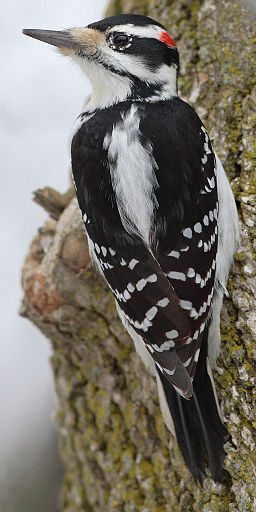
 Watching the hairy woodpecker
 Making her way
 Up the burnt and blackened ponderosa
 From recent wildfire
 Bark flicking off
 Probing, insistent pecking
 While the figures and shadows
 Of turkey vultures
 Cut across sky
 On this promontory
 Ridge with afternoon updraft
 And views
 out over
 The great valley
 Even to the Coast Ranges.


 Upholder of the way
 Keeper
 Of the practice
 Grooved deep in instinct
 Buddha
 To my bodhisattva
 I vow
 To listen
 To your braaap-bra-da-dap
 As intently as to
 A temple bell
 Calling
 To prayer.


 15 November 2019
 Kentucky Ridge, 2300’
 Moon past full, waiting for rain
Mid autumn Sun fled Rivers of color Drying up on each Black Oak Leaf
Down to the Underworld it goes Persphone’s paint pots All winter full.
ii.
Murmuring with silence This forest Cold air hugging ground Empty windows Between straight conifer tree trunks Arched Oak-leaf canopies fingering air With bare branches Like gasping sea-anemones Tendrils out of water
iii.
Slow dying Autumn leads processionals Throwing brown leaves everywhere Behind it Skittering shuffles of Towhee Hidden in the Kitkidize Each day’s step Closer to some heart of cold And darkness
Moon Trails behind Waxing ominously, eating sky With brightness Bragging heaven Of stars.
9 November 2019 Coffee Berry Hill Northern Sierra Foothills 2680'
 Eastside
 Up the Little Truckee
 yellowing
 meadows, rusty willows
 Cold Stream Creek
 iced edges
 October’s early snow
 crescents against volcanic headwalls

 Mt. Lola
 prominence highpoint
 November’s
 low-angled sun
 Sierra crest lifts choppy waves
 South, white-frothed
 All the way to Round Top
 Rose, in Nevada
 Arches her double back, east
 Lassen, leaning forward
 from far north
 close enough to taste
 with vision
 West wall of coast range
 holding the skirt
 of Central Valley, Sutter
 Buttes poking up
 through the haze and fog.

 All etched
 crystalline sky, dry autumn
 body laid out on its own
 operating table
 sagebrush summit
 white bark and mountain hemlock
 ourselves


 10 November 2019
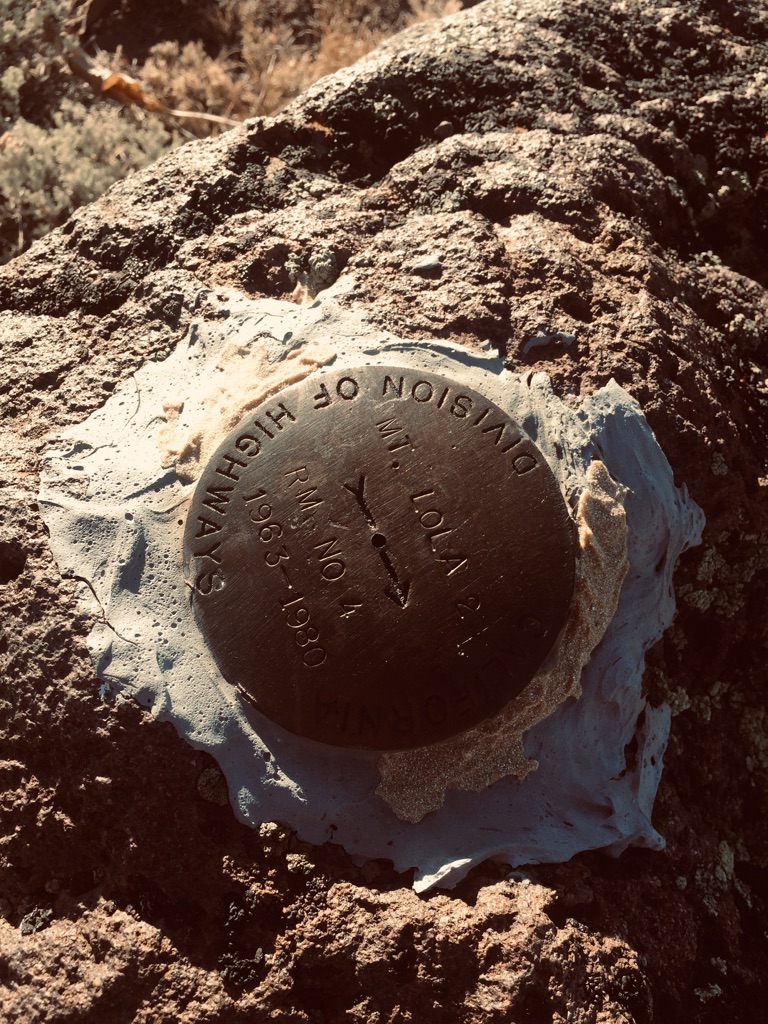
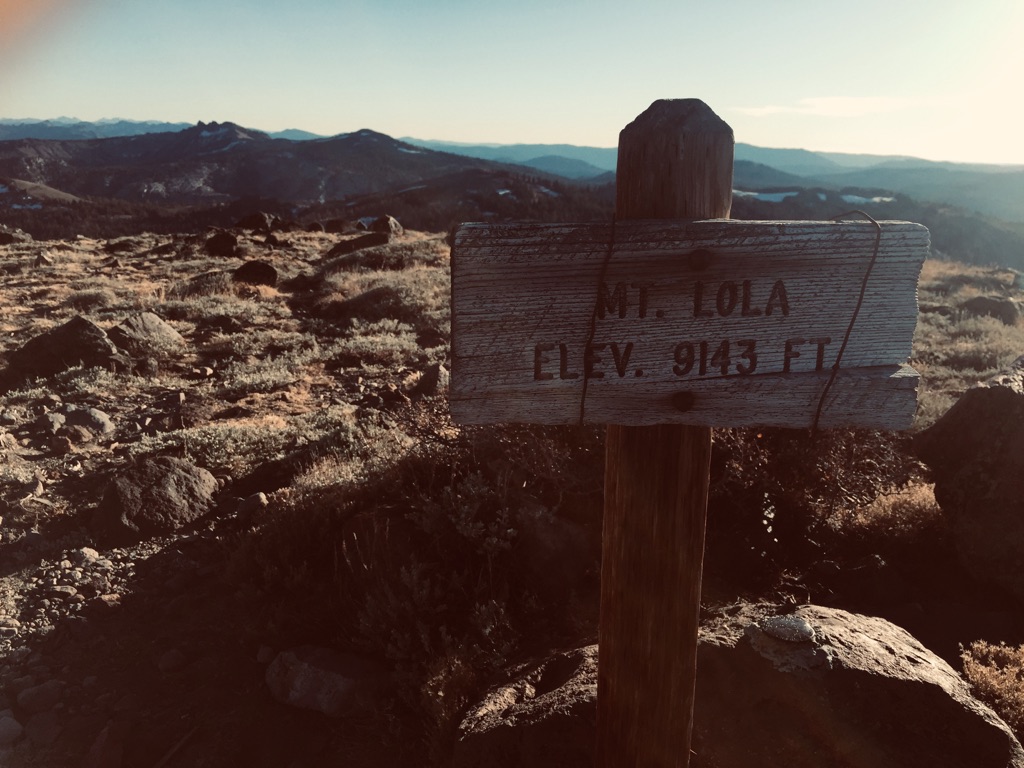
 Mt. Lola, 9,143’
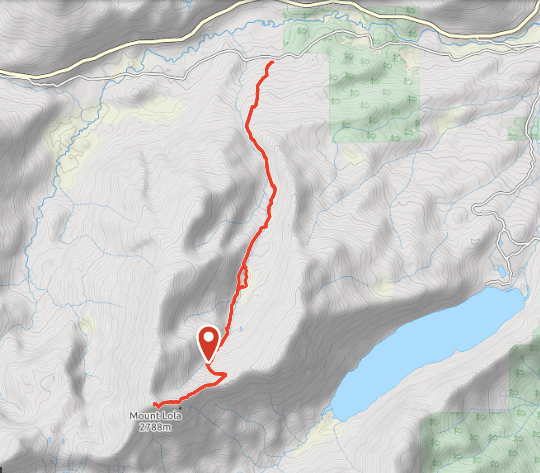
Cold Stream Canyon to Mt. Lola — 10 Nov. 2019, 1.5 hours to trailhead from Nevada City: Turn off from paved road, to the right, crossing the Little Truckee river and taking the first right onto the old Henness Pass Road, dirt, about 4 miles total to the signed trailhead, 9 miles return, about 2.5 hours ascent, elevation gain +2,500′
A party of seven, leaving from the trailhead a bit after 11 am and returning in the dark at 6 pm. Spent 2 hours on the wide, open summit, taking in the view, the warm sun, sky clear, almost windless, exceptional clarity.
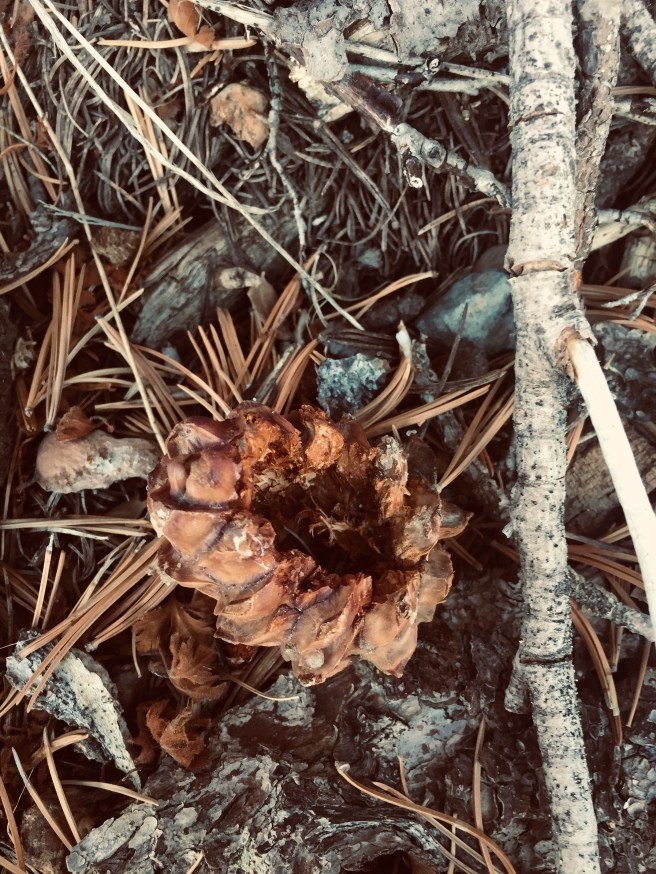
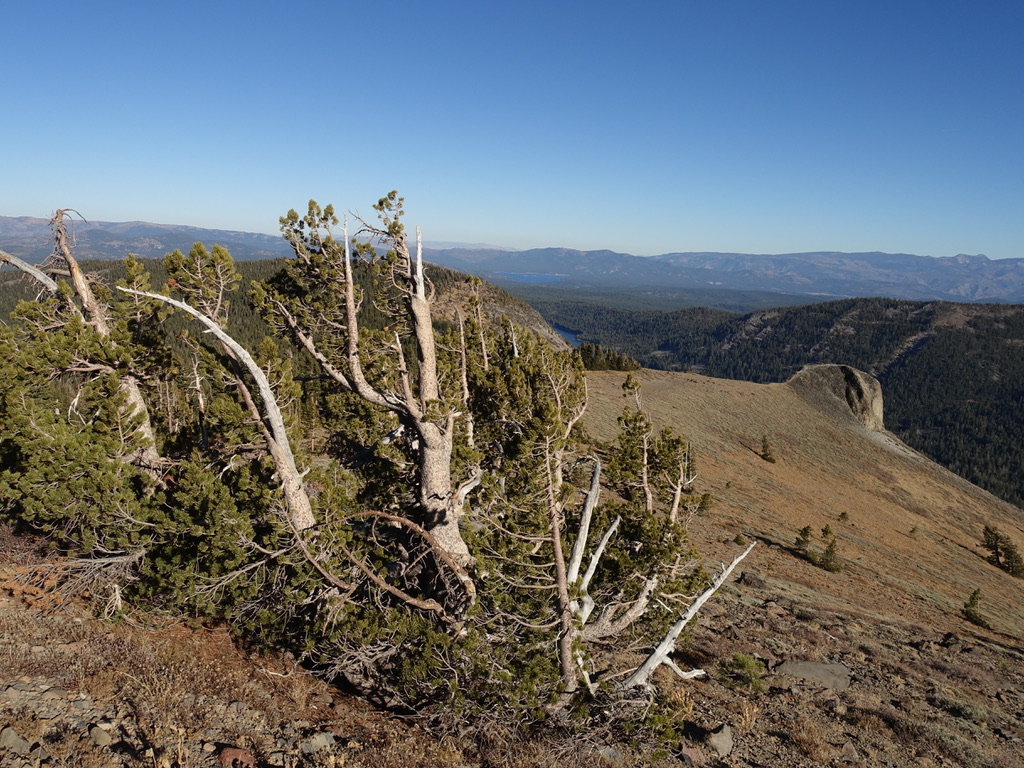
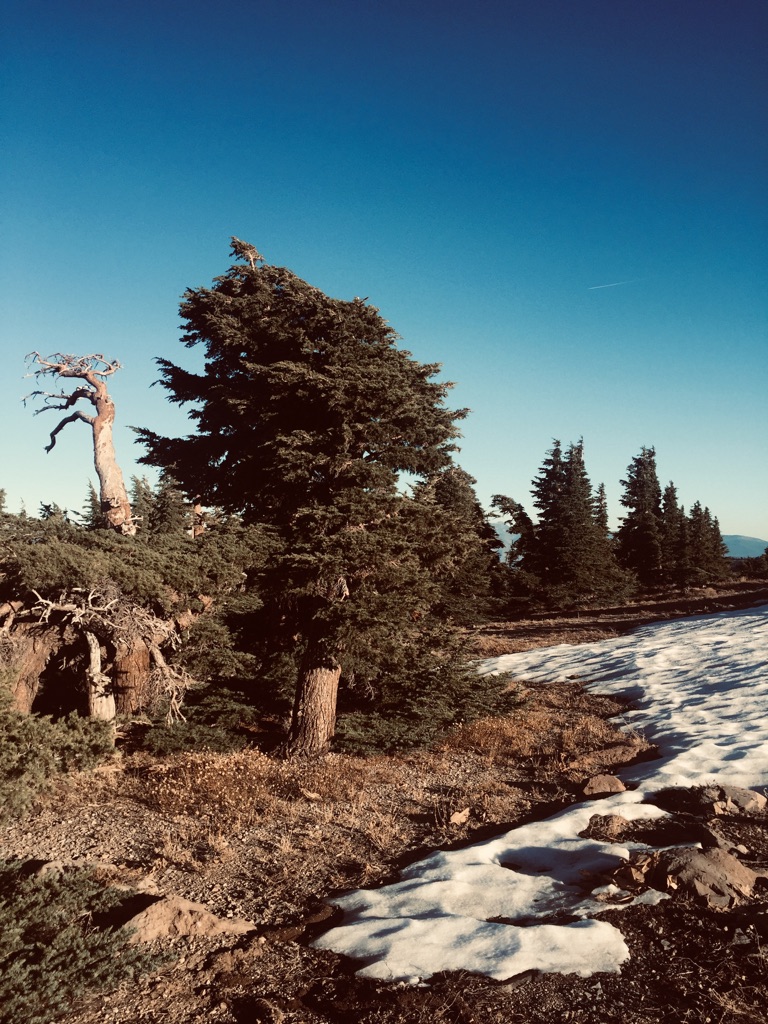
Upon close examination identified four conifer species on the summit in isolated stands — Jeffrey Pine (Pinus jeffreyi) on the warmer west and south slopes, Mtn. Hemlock down from the summit snowfields, Western White Pine (P. monticola) on the approach ridge, and one verified specimen of White-bark Pine (P. albicaulis), as indicated by the dense groups of 5-bunch needles, bark paler and less grooved than P. monitcola, and broken-apart cones at the base of the tree.
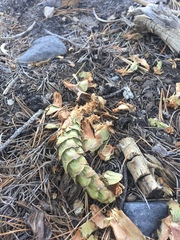
Along this section of the Northern Sierra, Pinus albicaulis is rare, occurring only on a few summits and ridges in the stretch between the higher Desolation Wilderness and the higher and more northerly Lassen National Park – Anderson Peak, Castle Peak and Basin Peak being the only locales presently identified. That the species can persist in very small numbers at wide intervals along the crest is intriguing. Clark’s Nutcracker, seen perched on a P. monticola during the descent, is a main dispersal agent. Further field work is needed to confirm rarity and distribution. This is hampered by the similarities between P. albicaulis and P. monticola, which is widespread on the approaches to the summits and adopts a ‘krummholz’ form very similar to P. albicaulis. Presence of cones is currently my only way to verify species definitively. For comparison, consider the cone of a Pinus monticola, found less than 10 meters away from the single, verified Pinus albicaulis:
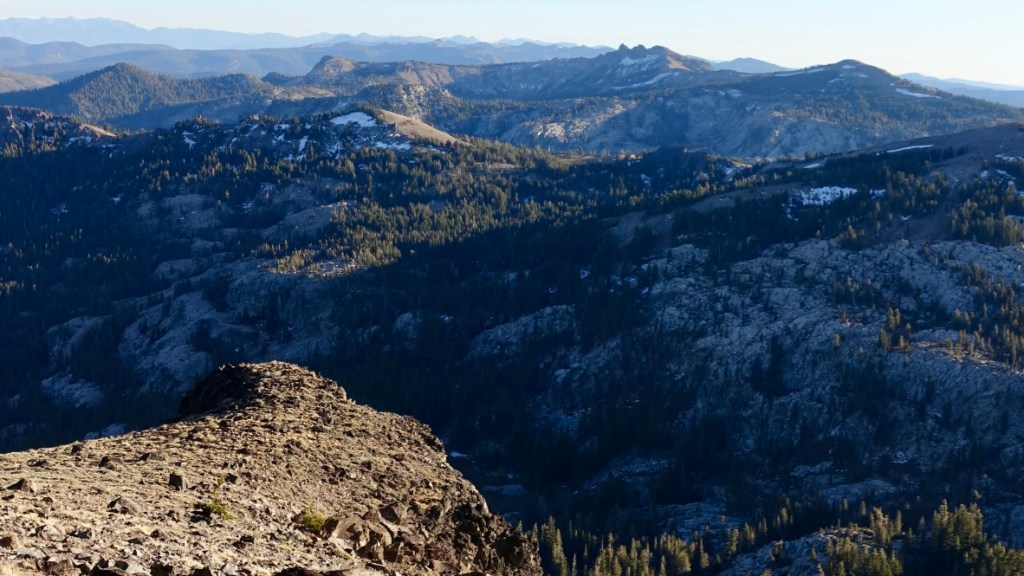
Mt. Lola itself is a center post of this tent landscape that is the Northern Sierra. Highest peak in our Yuba Watershed and in Nevada County, it is also has a prominence of over 2,000 feet, the nearest such peaks being Mt. Babbitt to the north and Pyramid Peak in Desolation to the south. With its flat summit and long, high ridges it stands as a viewing platform for the Northern Sierra. One gazes almost to the Pacific, with the Coast Ranges forming the western boundary and the vast Central Valley spread out below. To the east, there is Mt. Rose and first ranges of the Great Basin, with the high, dry Sierra and Martis valleys in between. To the north, the first great volcano of the Cascades, Mt. Lassen, looms, with the last crests of the Sierra trailing off. To the south, most dramatically, the Sierra Crest builds with peak upon peak, gradually rising up to sculpted Pyramid Peak, Round Top, beyond Carson Pass, and wide-saddled Freel Peak, lording over Lake Tahoe. This, then, is home country. On a crystalline day one feels the closeness and connectedness of the landscape, each feature flowing into the other, all equally part of my walking, traveling, visioning, dwelling body. Storms feed the summits here with water coming to my house, to local streams that wind their way through the foothills, with farms, gardens and orchards that bring food to my table. To the east, dry lands connect me to the wet, Pacific slopes precisely because of their dryness. It is the necessary balance, the yin-yang of earth, wet, forested range bound to dry, rain-shadow hinterlands. In similar ways, I am connected north to south by the cresting ranges themselves. My foothills and their high peaks stand only in solidarity with the whole range of peaks. They cannot exist alone. All of them, they participate in that same rise and stretch of continent, age-old, with its volcanics, its fault blocks. On Mt. Lola this day, I stand atop an axis mundi, a shaman’s pole from which heaven is not far and the rootedness of earth drives itself firm.
In some faint way, we all feel it, journeying up here. Mountain bikers who passed us on the trail linger on the summit with us before making their extreme, quick descent to cars below. Other hikers join us, finding their own solitary vistas. We pry open the metal summit log box to leave a note of our visit here. The mountains stare at us with their own open mouths, each their own tent poles holding up the whole-earth fabric as much air and stars as ridge and valley. Pleasure hike fuses in this modern age with the echoes of pilgrimage – for me, simply to the center of ourselves, to the home altar we speak from and breathe from that is everywhere.
 Mountaineity